

Choose bathroom wall panels by starting with water exposure and the complete installation system, not the pattern on the face. A shower wall needs a product and joint system intended for repeated direct water exposure. A vanity wall or decorative wall may only need to tolerate occasional splashes and bathroom humidity.
If you want a fast shortlist, use this rule: compare shower-rated acrylic or solid-surface systems for a premium direct-wet installation; compare a shower-approved PVC system when budget and easier handling matter; consider laminate or solid-core systems when you want a more substantial decorative finish; and consider FRP where practical durability and cleanability matter more than a luxury appearance. The material name alone is not enough. The exact product, core, seams, trims, adhesive, sealant, substrate and installation instructions determine whether the finished wall is suitable for its location.
A useful distinction is simple: a waterproof panel is not automatically a waterproof wall system. In U.S. residential construction, the International Residential Code includes a requirement for nonabsorbent finishes in shower compartments and on walls above tubs with shower heads; the locally adopted code and the specified system should always control the project. See the International Residential Code guidance for bathtub and shower spaces.
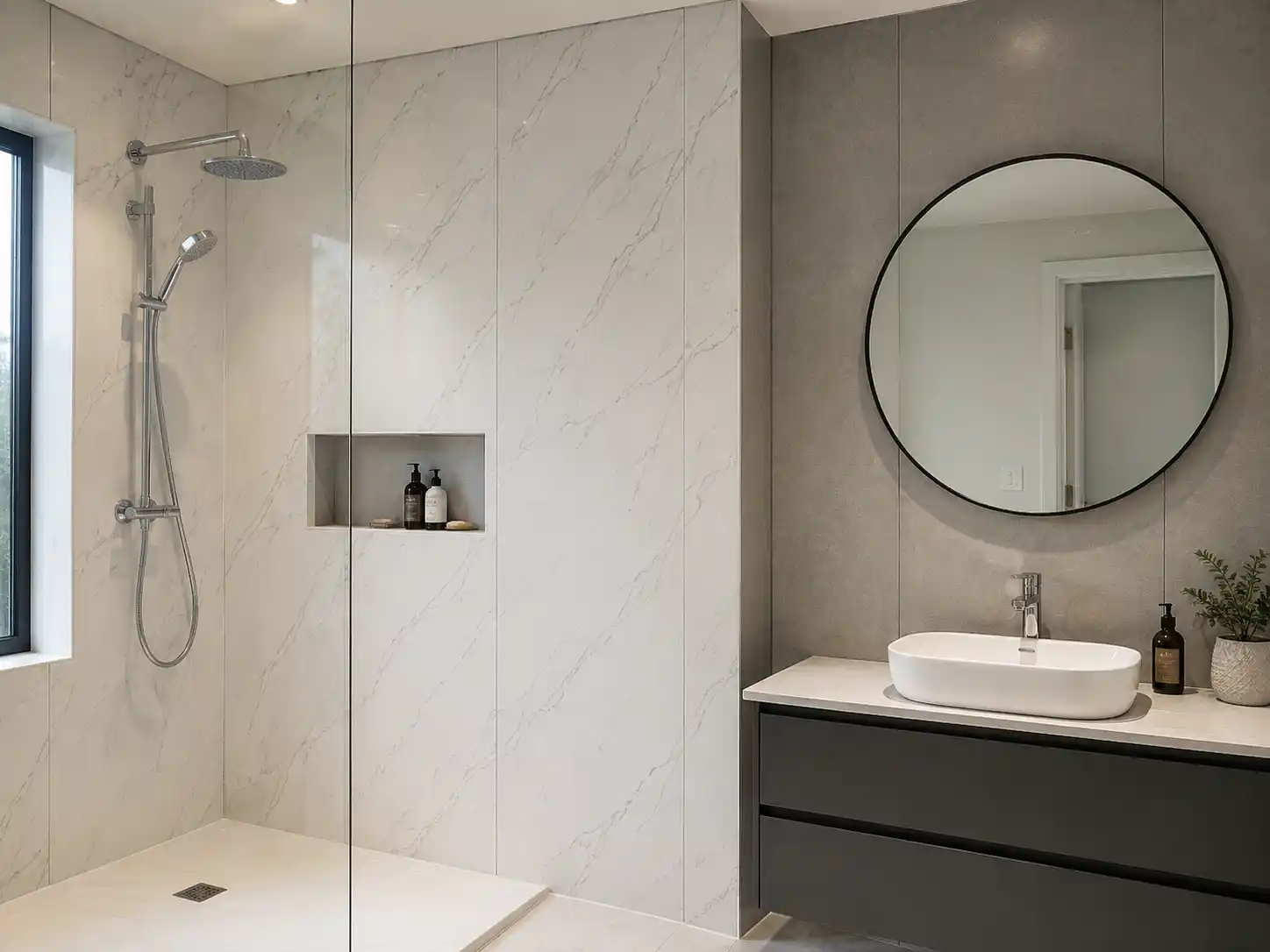
Bathroom Wall Panel Decision Matrix
The table below is a purchasing guide, not a universal performance rating. Products within the same material category can differ substantially in core construction, thickness, joint design, surface treatment and approved application.
| Material | Usually Worth Comparing For | Direct-Wet Use | DIY Difficulty | Relative Cost | Key Buying Check |
|---|---|---|---|---|---|
| PVC | Budget renovations, lighter panels, simpler handling | Product-dependent; use only a system approved for the wet zone | Low to medium | $ to $$ | Core construction, impact resistance, joints and wet-area approval |
| Acrylic | Modern shower surrounds and large smooth surfaces | Commonly available in shower systems; verify the exact system | Medium | $$ to $$$ | Cutting, scratching, plumbing penetrations and seam treatment |
| Laminate or solid-core | Premium residential bathrooms and decorative realism | Product-dependent | Medium to high | $$$ | Core protection, cut edges, joints and substrate requirements |
| Fiberglass or FRP | Utility, commercial or higher-use spaces | Product-dependent | Medium | $$ | Approved application, joint profiles, substrate and finish quality |
| Solid surface | Premium shower applications and low-joint visual finishes | Suitable systems are available; verify the specified assembly | High | $$$ to $$$$ | Weight, fabrication, seam treatment and installer requirements |
| SPC, WPC and other composites | Projects where a specific composite system fits the design | Cannot be assumed from the material label | Varies | Varies | Exact construction, water-exposure rating and installation manual |
1. Start With the Bathroom Wet Zone
Do not treat every bathroom wall as the same environment. Divide the room into three practical zones before comparing products:
- Direct-wet: shower enclosures, shower-over-tub surrounds and walls repeatedly hit by water.
- Splash-prone: areas around vanities, sinks and tubs that receive intermittent water.
- Lower-exposure: walls away from plumbing fixtures that mainly experience humidity and normal cleaning.
This single step prevents a common buying error: choosing a panel described as "moisture-resistant," "water-resistant" or "bathroom suitable" and assuming that automatically makes it appropriate inside a shower. For direct-wet walls, ask the supplier to identify the exact approved application and provide the installation document that covers joints, corners, bottom edges and plumbing penetrations.
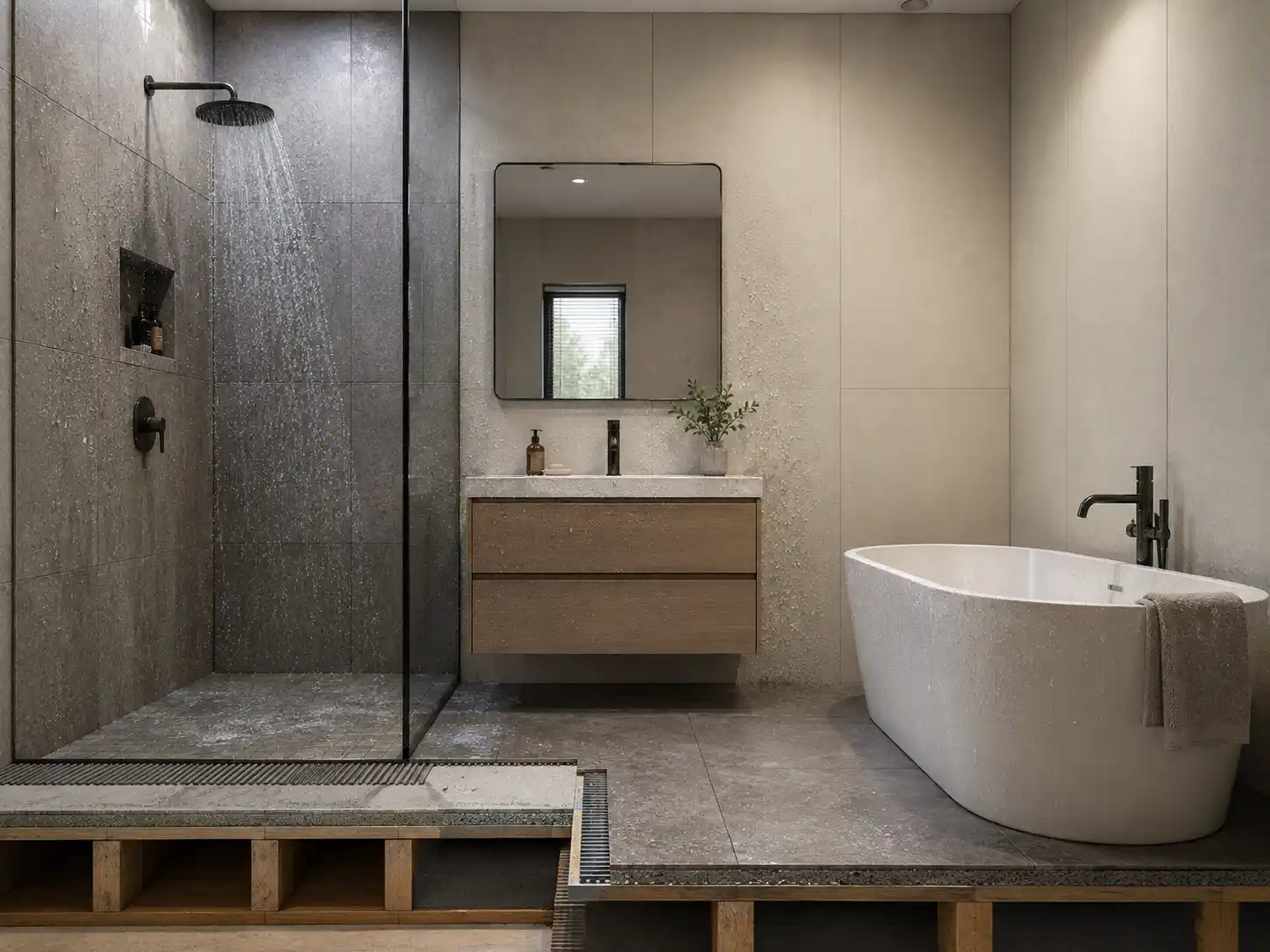
2. Compare the Panel Construction, Not Just the Surface
Two bathroom wall panels can look nearly identical in a product photo while behaving differently in service. Compare the structure behind the decorative face:
- core material and density;
- overall panel thickness;
- surface layer or coating;
- edge profile and joining method;
- weight and handling requirements;
- impact and scratch resistance;
- permitted adhesives and sealants;
- approved substrates;
- wet-area or direct-water suitability;
- warranty conditions.
For example, "PVC wall panel" can describe products with different cores, profiles and intended uses. If PVC is on your shortlist, compare the construction and options in the PVC wall panel range rather than treating every PVC panel as interchangeable.
3. Evaluate the Complete Water-Management System
The face of the panel is only one part of a wet-area installation. Water can reach the substrate through weak points if the system is poorly detailed.
Pay particular attention to:
- vertical joints between panels;
- inside and outside corners;
- the bottom edge above a shower tray or bathtub;
- cut edges;
- openings around faucets, valves, pipes and shower fittings;
- transitions to ceilings, floors or other wall finishes.
The adhesive, trims and sealant must also be compatible with the panel and substrate. ASTM's C920 specification for elastomeric joint sealants explicitly recognizes that a sealant meeting a specification is not automatically suitable for every application or substrate. For a bathroom panel project, the safest purchasing approach is therefore to use the components and joint details specified for the exact wall system rather than substituting products based only on a generic "waterproof" label.
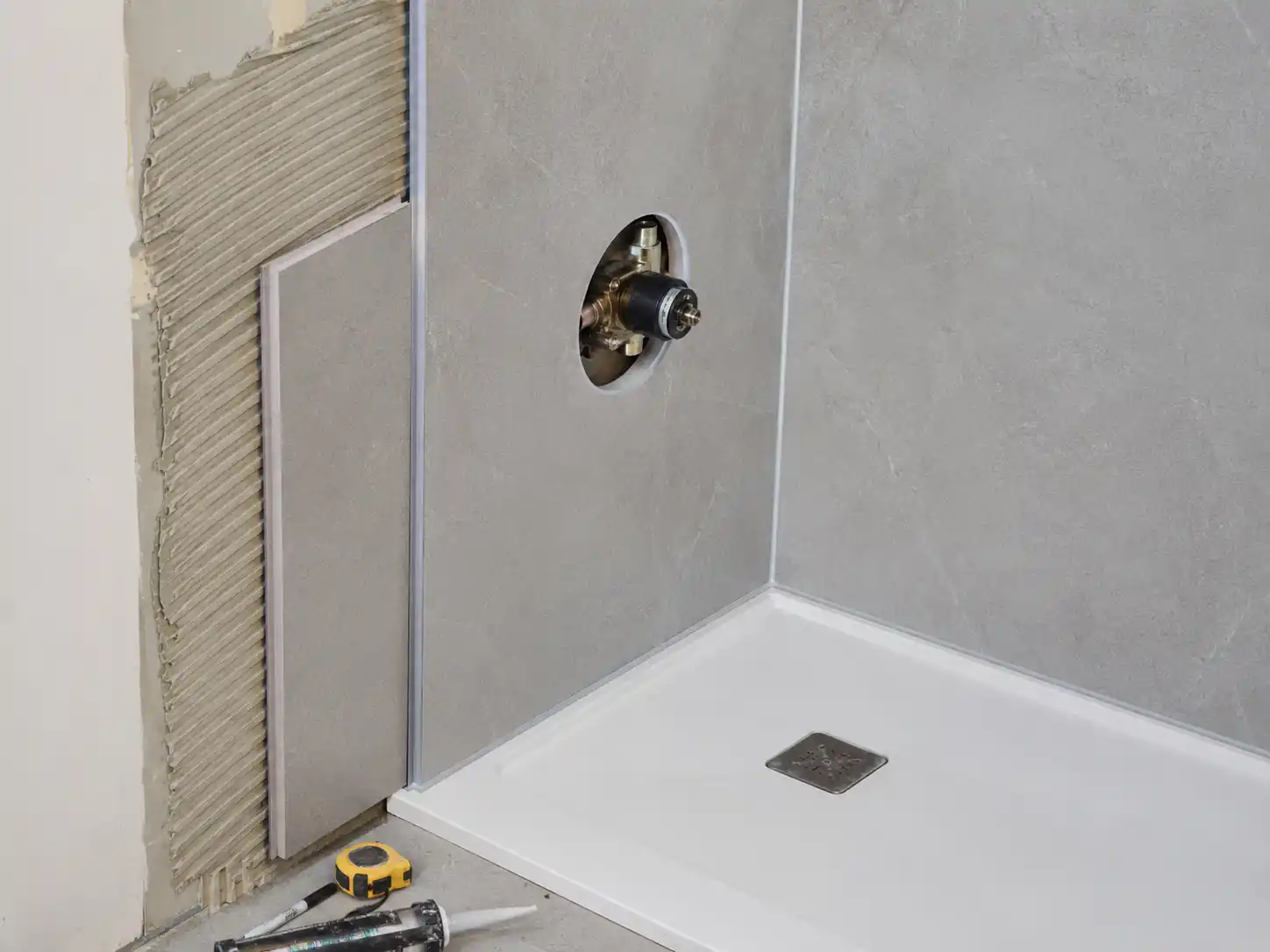
4. Choose the Material by the Job It Needs to Do
PVC Bathroom Wall Panels
PVC is often the first material to compare when weight, budget and installation simplicity are important. It is available in many decorative finishes and can be easier to handle than heavier sheet systems.
However, construction varies. Hollow profiles, composite-core panels, solid PVC products, coatings, thicknesses and joint designs should not be grouped together as if they have identical performance. For shower applications, only use the exact PVC system if its documentation permits that exposure.
For a concrete product example, review the specifications for bathroom wall cladding PVC panels, then confirm whether the selected specification is appropriate for the exact wet zone in your project.
Acrylic Shower Wall Panels
Acrylic is worth comparing when a clean, contemporary shower finish and large continuous surfaces are priorities. Larger sheets can reduce the number of visible joints compared with small-format tile.
The tradeoff is precision. Cutting, edge finishing and plumbing penetrations need careful planning, and scratches can be more visible on some polished surfaces. Before purchase, confirm the panel dimensions, installation sequence, cutting method, joint treatment and compatible sealant.
Laminate and Solid-Core Bathroom Panels
Laminate and solid-core systems can provide convincing marble, stone, concrete or other decorative effects with a more substantial feel than some lightweight panels. They are often worth comparing for premium residential projects.
The vulnerable details are usually not the decorative face but the complete edge and seam treatment. Ask how cut edges are protected, how internal corners are formed, whether trims are required and what substrate tolerances apply.
Fiberglass and FRP Panels
Fiberglass and FRP products are commonly considered where cleanability, durability and practical performance have priority over a luxury residential look. The category is broad, so confirm whether the exact sheet, adhesive and joint system are intended for the bathroom environment you are specifying.
Solid Surface and Other Composite Panels
Solid-surface systems can create a premium, low-joint appearance and are worth comparing for higher-end showers. They are usually heavier and more fabrication-intensive, so professional installation may be the better route.
SPC, WPC and other composite labels require even more caution because the same broad name can cover very different constructions. Treat the technical data sheet and installation manual as the product definition.
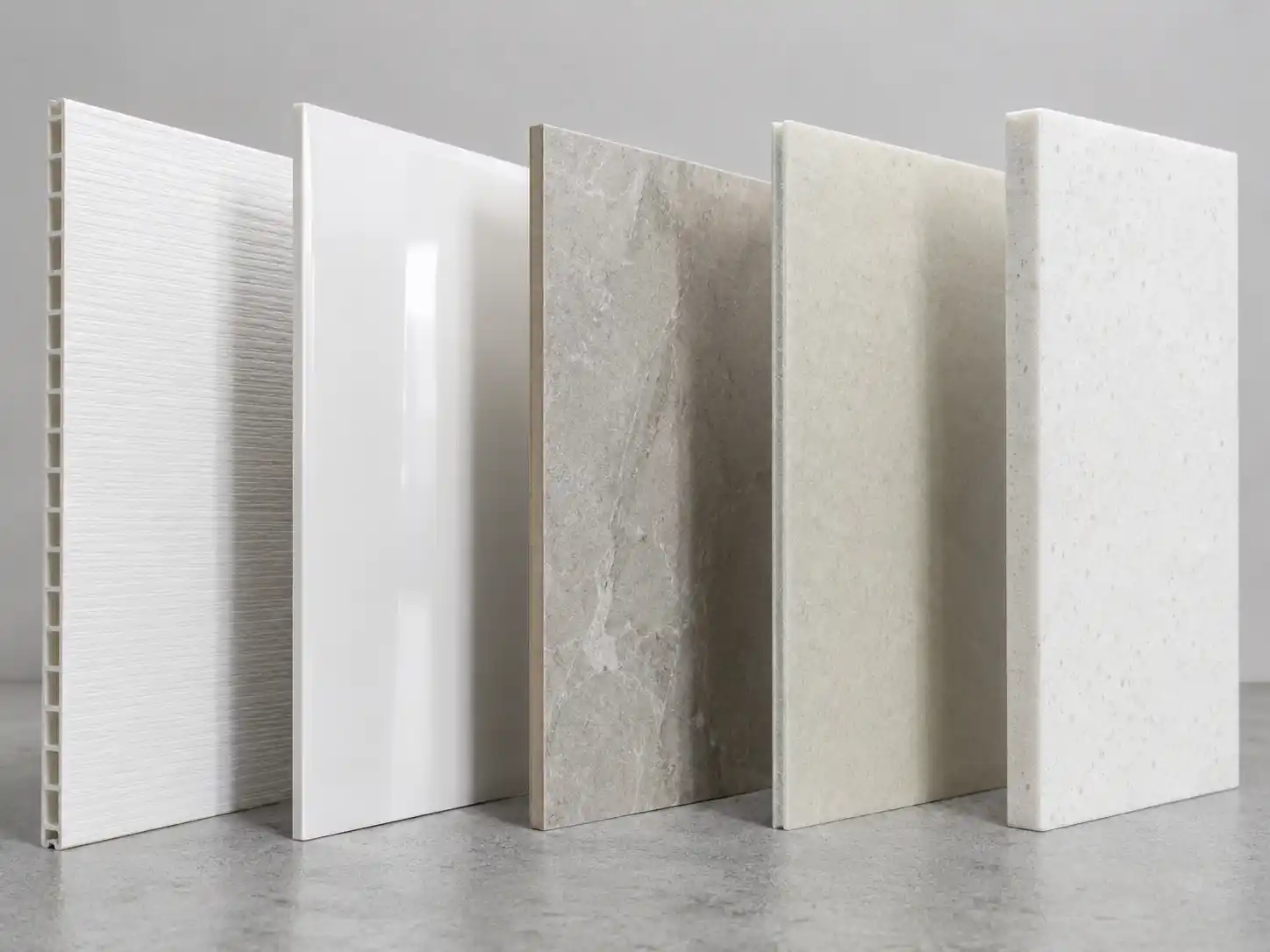
5. Match the Panel to Your Priority
Best Starting Point for Shower Walls
For shower walls, start with systems explicitly intended for direct-wet use. Acrylic and solid-surface shower systems are strong candidates when finish quality and fewer visual joints matter. A shower-approved PVC system can be attractive when budget and easier handling are priorities. Premium laminate or solid-core products can also work when their complete system is specified for the application.
The decisive question is not "Which material is waterproof?" It is "Which exact system is approved for this shower, and how are its seams, corners and penetrations sealed?"
Best Starting Point for a Budget Bathroom Remodel
PVC is often the first category to price because many systems are light and relatively straightforward to install. Compare the complete project cost rather than panel price alone: panels, trims, adhesive, sealant, substrate preparation, waste and labor all matter. For a separate planning reference, see the site's PVC wall panel cost guide, then confirm current project pricing with an actual quotation.
Best Starting Point for DIY Installation
Do not define "DIY-friendly" only by how easily the material cuts. A straightforward system should also have clear instructions, manageable panel dimensions, simple joining details, available trims and well-defined adhesive and sealant requirements.
Room geometry matters just as much as material. Niches, windows, out-of-square walls, concealed pipes and multiple corners can turn an easy-looking installation into a precision job. General panel fitting videos are available on the wall panel installation page, but wet-area products may require different details, so the product-specific installation manual takes priority.
Best Starting Point for a Premium Bathroom
Compare acrylic, premium laminate, solid-core and solid-surface systems when visual scale, seam control and a substantial finish matter more than minimum material cost. Judge the product at full-wall scale. A small sample can confirm color and texture, but it cannot show pattern repetition, joint visibility or how the finish reads across several panels.
6. Bathroom Wall Panels vs. Tile
| Factor | Bathroom Wall Panels | Tile |
|---|---|---|
| Installation | Large panels can cover substantial wall area quickly | Installed piece by piece |
| Joints | Usually fewer, but each joint must be correctly detailed | Many grout joints |
| Cleaning | Large smooth surfaces can reduce joint cleaning | Tile faces are easy to clean; grout needs separate attention |
| Design flexibility | Wide range, but limited to the chosen system | Very broad choice of formats, layouts and combinations |
| Renovation | Some systems can cover suitable existing finishes | Often requires more surface preparation or demolition |
| Repair | Depends on how the panel system is joined and installed | Individual tiles can sometimes be replaced |
| DIY difficulty | Some systems are approachable for experienced DIY users | Good layout, cutting, waterproofing and grouting require skill |
Choose panels when quick coverage, fewer joints and simpler routine cleaning are high priorities. Choose tile when maximum design flexibility, traditional tiled detailing or individual-piece replacement matters more. A bathroom can also use both: for example, a dedicated wet-area system in the shower and another wall finish elsewhere.
7. Can Bathroom Wall Panels Be Installed Over Existing Tile?
Sometimes, but only when the panel manufacturer permits it and the existing wall is a suitable substrate. Do not use new panels to hide a failing wall.
- Check adhesion: loose or hollow-sounding tiles need investigation.
- Check moisture: leaks, dampness, mold, staining or soft substrate must be addressed first.
- Check flatness: large panels can telegraph significant irregularities or fail to seat correctly.
- Check cleanliness: soap film, oils and other contaminants can interfere with bonding.
- Check added thickness: confirm how the new wall build-up affects taps, valves, trims, shower doors and other fixtures.
- Check adhesive compatibility: the adhesive must suit both the panel backing and the existing tile surface.
The U.S. Environmental Protection Agency emphasizes moisture control as the key to mold control and recommends fixing water problems rather than simply covering their effects. If a wall shows signs of water damage, review the EPA's guide to mold, moisture and the home and correct the source before installing a new finish.
8. Measure the Wall Before You Order
Measurement errors become expensive when large panels, decorative pattern matching and custom fabrication are involved. Build a wall-by-wall cutting plan instead of using only the room's total square footage.
- Measure each wall separately at more than one point if the room may be out of square.
- Record internal and external corners.
- Mark doors, windows, niches, recesses and boxed-in services.
- Locate every plumbing penetration and accessory fixing.
- Confirm whether the quoted panel width is the overall width or the effective installed coverage after joints overlap or interlock.
- Allow for the supplier's recommended waste, pattern matching and spare material.
If panels are customized, confirm finished dimensions before production. Changes in thickness or joint profile can affect usable coverage and trim selection.
9. Check the Existing Wall Before You Choose the Finish
The best panel cannot compensate for a failing substrate. Before ordering, identify what the panels will be fixed to: masonry, cement board, tile, plaster, drywall or another approved substrate. Then compare that condition with the product's installation requirements.
Look for:
- loose finishes;
- movement or cracking;
- signs of leaks;
- mold or persistent dampness;
- severe unevenness;
- contamination that could reduce adhesive bond.
This is also the point to decide whether the wall needs repair, leveling or another preparation step before panel installation begins.
10. Maintenance, Repair and Replacement Matter Before Purchase
"Easy to clean" is too broad to make a buying decision. Ask which cleaners are permitted, whether abrasive pads can damage the finish, how hard-water deposits should be treated, whether scratches can be repaired and whether one damaged panel can be replaced without dismantling the surrounding wall.
In high-use family or commercial bathrooms, repairability can matter as much as appearance. A finish that looks excellent on day one but requires a difficult full-wall replacement after local damage may have a higher lifecycle cost than a more serviceable system.
11. Choose the Design After the Technical Requirements
Once the wet-area, substrate and installation requirements are satisfied, compare appearance. Common wall-panel finishes include marble, stone, concrete, wood effects, tile effects, solid colors, gloss, matte and textured surfaces.
Use a physical sample where possible. A screen cannot accurately show gloss level, tactile texture, print depth or the scale of a stone pattern across an entire wall. It is also useful to review completed installations in a project case library to judge how materials read at room scale rather than as isolated sample pieces.
Common Bathroom Wall Panel Buying Mistakes
- Choosing by appearance first: an attractive panel is still the wrong panel if it is not approved for the wet zone.
- Treating "waterproof" as a system guarantee: joints, corners, edges and penetrations still need correct detailing.
- Ignoring the substrate: covering moisture damage hides the problem instead of fixing it.
- Comparing only material names: two PVC or composite panels can have very different cores and joint systems.
- Buying before checking trims: corners, ends and transitions can affect both appearance and total cost.
- Substituting adhesive or sealant: compatibility is product- and substrate-specific.
- Comparing only purchase price: include preparation, accessories, labor, maintenance and potential repair.
Frequently Asked Questions
What type of bathroom wall panel is best?
There is no single best material for every bathroom. For direct-wet shower walls, start with systems specifically approved for that application. Acrylic and solid surface are strong premium candidates; shower-approved PVC can be attractive for budget and easier handling; laminate, solid-core and FRP systems can suit other priorities when their technical documentation matches the wet zone.
Are PVC wall panels good for bathrooms?
They can be, but "PVC" alone does not establish where a product should be installed. Compare the exact core, thickness, joining system, substrate requirements and wet-area approval. A panel suitable for a humid bathroom wall is not automatically suitable inside a shower.
Are bathroom wall panels completely waterproof?
Some panel materials have very low water absorption or are marketed as waterproof, but the completed installation also depends on joints, corners, edges, sealant, trims and plumbing penetrations. Evaluate the complete wall system.
Can bathroom wall panels go over tiles?
Some systems can be installed over stable, clean, sufficiently flat existing tile when the manufacturer permits it and the specified adhesive is compatible. Moisture damage, loose tiles and substrate failure should be corrected first.
Do bathroom wall panels need grout?
Many wall panel systems are grout-free. They may use tongue-and-groove joints, sealant, trims, profiles or proprietary connectors instead. Grout-free does not mean joint-free, so the connection details still matter.
Are bathroom wall panels better than tile?
Panels are often preferable when faster coverage, fewer joints and easier routine cleaning are priorities. Tile offers broader pattern and format flexibility and can allow local replacement of individual pieces. The better option depends on the project rather than one material being universally superior.
What should I ask a supplier before buying shower wall panels?
Ask for the wet-area approval, technical data sheet, installation manual, substrate requirements, joint and corner details, specified adhesive and sealant, cleaning instructions, warranty, sample and any relevant test documentation. If the supplier cannot show how the complete system is installed in a direct-wet area, do not rely on a generic "waterproof" claim.
Final Recommendation
The most reliable way to choose bathroom wall panels is to work in this order:
water exposure → approved panel system → substrate → joints and sealing → installation → maintenance and repair → design → total project cost
That sequence makes the decision faster because it removes unsuitable products before you spend time comparing colors and patterns. For a shower, prioritize direct-wet approval and system detailing. For a lower-exposure bathroom wall, you have more freedom to optimize appearance, budget and installation speed.
If you are sourcing panels for a residential, hospitality or commercial project, prepare the wall dimensions, wet-zone location, substrate, target finish and required quantity before contacting the supplier. You can request specifications, samples and a project quotation with those details so the proposed panel can be checked against the actual application.