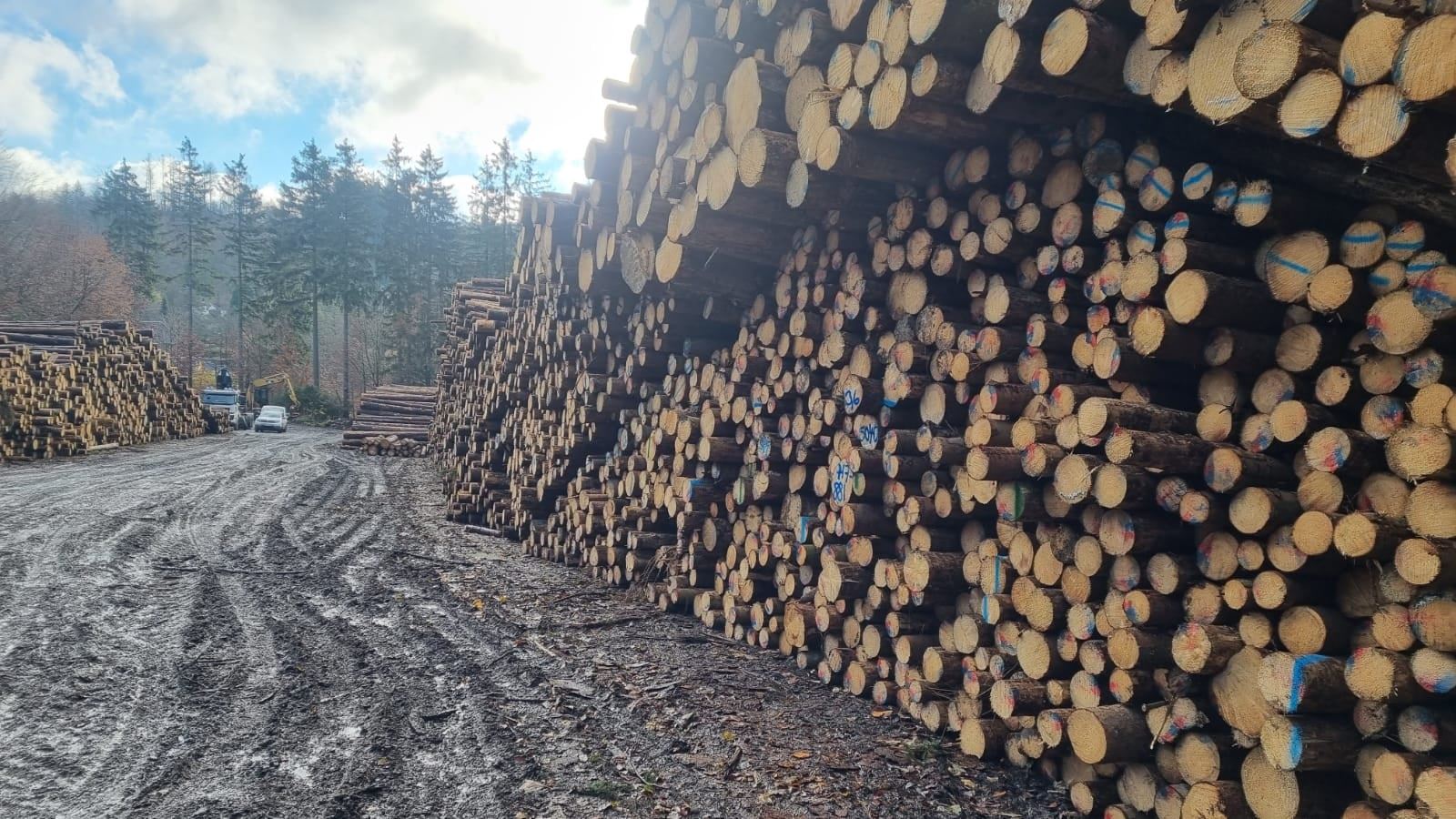
Recently, the Russian government once again announced that from January 2 to December 31, 2022, it will increase the export tax rate of rough-processed wood with a humidity of more than 22% and a thickness and width of more than 10 cm. Among them, the export tax for softwood logs is 200 euros per cubic meter, and the export tax for precious hardwood logs such as oak, beech, and ash is 250-370 euros per cubic meter.
In order to promote the development of the domestic timber deep processing industry, since 2021, Russia has revised its timber export policy three times.
first revision
The first revision announced that starting from July 1, 2021, the Russian government will impose a 10% export tariff on rough-processed timber with a humidity exceeding 22%, in order to restrict the export of rough-processed timber in the name of sawn timber and curb domestic sawn timber prices. , to stimulate timber enterprises to produce high value-added products.
second revision
The second revision announced that from 2022, Russia will ban the export of softwood logs or rough processed wood.
The third revision
The third amendment announces an increase in the export tax rate for rough-processed wood with a humidity exceeding 22% and a thickness and width of more than 10 cm from 2 January to 31 December 2022
In the past two years, affected by factors such as the new crown pneumonia epidemic, the trade of forest products between China and Russia has been greatly impacted. Since 2021, with the improvement of the epidemic situation, bilateral trade in forest products has rebounded rapidly. From January to October, the cumulative import and export volume reached 5.83 billion US dollars, a year-on-year increase of 16.0%; of which, the import value was 4.99 billion US dollars, a year-on-year increase of 16.4%; exports The amount was US$840 million, a year-on-year increase of 13.5%.
Timber imports · Imported logs
From January to October 2021, my country imported 5.71 million cubic meters of logs from Russia, a year-on-year increase of 4.6%, accounting for about 10.7% of my country's total log imports, ranking third.
Timber import and imported sawn timber
Imported sawn timber was 12.04 million cubic meters, down 12.4% year-on-year, accounting for 49.9% of my country's total sawn timber imports, ranking first.
Timber import, pulp, and paper
In addition to wood, my country also imports a large number of pulp and paper products from Russia. Among them, the import volume of wood pulp was 1.189 million tons, a year-on-year decrease of 2.8%; the import volume of paper, cardboard, and paper products was 917,000 tons, a year-on-year increase of 60.5%.
Chinese-funded enterprises in Russia generally believe that the policy of banning the export of Russian logs has long been expected, and the adjustment of the timber export policy has little impact on deep-processing enterprises, which will further guide enterprises to develop in the direction of intensive timber processing. The main reason is that the export quota system for Russian logs has been implemented in recent years. The timber within the quota can enjoy a lower tariff of 13%, and the extra tariff can be as high as 80%. The current log export quota is 4 million cubic meters, and the Russian government originally planned to reduce it by 2 times.
Since 2013, New Zealand has surpassed Russia to become my country's largest source of log imports. In 2020, Germany has surpassed Russia to become my country's second-largest log importer. This also alleviates the passive situation of log imports brought to my country due to the adjustment of Russia's timber export policy to a certain extent. On the other hand, due to the lack of funds and technology in Russia, the production equipment cannot be updated and improved in time, and the deep processing capacity of wood cannot meet the demand. Once Russia bans log exports, Russia will also suffer corresponding losses.
Under the existing policies, my country should continue to tap the potential of wood and forest products trade and investment between my country and Russia, and improve the level of cooperation in four aspects.
Encourage enterprises to increase investment in wood deep processing, focusing on priority investment areas announced by Russia. For example, Russia will use processed waste and low-quality wood to build biopower and pulp mills as key projects.
To jointly promote the construction of wood processing parks, it is necessary to adapt to the new situation of Russia's continuous tightening of log export policies, adjust cooperation strategies in a targeted manner, build an overseas wood processing park integrating forest harvesting, wood processing, logistics and services, and extend the industrial chain. , to promote the upgrading of industrial structure.
Carry out research on Russia's own characteristics, fully grasp the international trade and domestic market dynamics of Russian wood forest products, and adjust its own product types in a timely manner to meet the market demand of the other party.
Further, strengthen non-governmental cooperation, establish a normalized contact mechanism between forestry enterprises, associations, and chambers of commerce in the two countries, build a better communication platform for cooperation between enterprises of the two sides, and create conditions for project docking and personnel flow to achieve mutual benefit and win-win results.