

Begonia wood takes more than 150-200 years to become wood. It is a precious hardwood, commonly known as red sandalwood in Southeast Asia. Scientific name: Calophyllum, Garcinia genus Begonia, mainly distributed in Southeast Asia, Indonesia, Malaysia, Sarawak - code BINT, Calophyllum (Papua New Guinea - code CAL, Solomon Islands - code CA/CL), Bintangor Laut (Malaysia), In areas such as Bitaog (Philippines), the main manifestations of the outer skin of Begonia wood are: the groove edge is a major feature of Begonia wood, which is very obvious. column method.
Basic Information
Chinese name: Begonia wood.
Latin name: Calophyllum
Aliases: ice candy, red thick shell wood, small mahogany
Kingdom: Plant Kingdom
Family: Garciniaaceae
Genus: Begonia
Species: Begonia
Distribution area: Indonesia, Malaysia, Myanmar, Thailand
Morphological characteristics
Trees and distribution: Evergreen trees with pale yellow sap are often left on the surface. There are about 100 species of this genus, which are distributed in Southeast Asia, South Pacific, Madagascar, and South America, and are mainly imported from Malaysia, Papua New Guinea, Solomon Islands, and Indonesia.
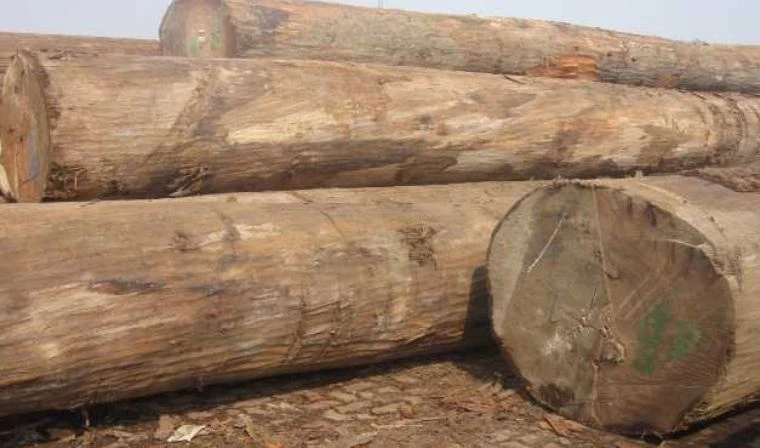
Bark: Very thick, sometimes up to 4cm, not easy to peel off. The outer skin is hard; thick; gray-white to gray-brown; longitudinally fissured, deeper and wider; easy to flake off. The endothelium is reddish-brown; the bast fibers are well developed; the stone cells are well developed; the layers are arranged.
Cross-section: The heart and sapwood are clearly differentiated. The heartwood is rose red to reddish-brown with thin brown streaks. Part of the section shows a beautiful chicken wing pattern, and the sapwood is light yellow or light gray-brown, narrow. Growth rings are slightly visible.
Diffuse-porous wood, the tube pores are obvious to the naked eye; single tube pores; oblique or radial; with dark gums. The axial parenchyma is obvious under a magnifying glass, and it is strip-shaped from the tube, intermittent and sparse, and uneven. Slightly seen under the wooden ray magnifying glass, slightly dense, very narrow.
distribution area
Origin: Bintangor (Indonesia, Malaysia, Sarawak - code BINT), calophyllum (Papua New Guinea - code CAL, Solomon Islands - code CA/CL), Bintangorlaut (Malaysia), Bitaog (Philippines), China (China), Tanghon, Kathing (Thailand), Mentangol, Damanu (Fiji), Penaga (Sabah), pongnget (Myanmar), Bunut (New Guinea) Beauty-leaf.
wood properties
1. Begonia wood has good drying performance, is not easy to crack and warp, and is a good wood for making solid wood furniture.
2. Tube holes are obvious to the naked eye; slightly less, single tube holes, oblique or radial; axial parenchyma is obvious under a magnifying glass, but slightly visible under a wood ray magnifying glass.
3. Strong gloss, staggered texture; fine structure, good paint, and polishing performance, and strong corrosion resistance.
wood use
Begonia wood is a high-end furniture material, and it is also called small mahogany because its texture color is similar to that of rosewood. Generally suitable for high-end solid wood furniture, bridges, sleepers, musical instruments, handicrafts, etc.