

Finding wall panel manufacturers in China is easy. Finding a supplier that can repeatedly deliver the exact material, finish, dimensions, documentation, packaging and quality level your project requires is much harder.
This guide is written for importers, distributors, contractors, architects, interior-design firms and project buyers comparing Chinese wall panel suppliers. It covers WPC, SPC, solid-wood, acoustic and other decorative wall systems, then explains how to qualify a supplier before placing a commercial order.
Research note: Company product lines and public information were checked in August 2026. The numbering below is an editorial research order, not an independently audited score from best to worst. A supplier that is a strong fit for an acoustic project may be a poor fit for an exterior WPC project, and vice versa.
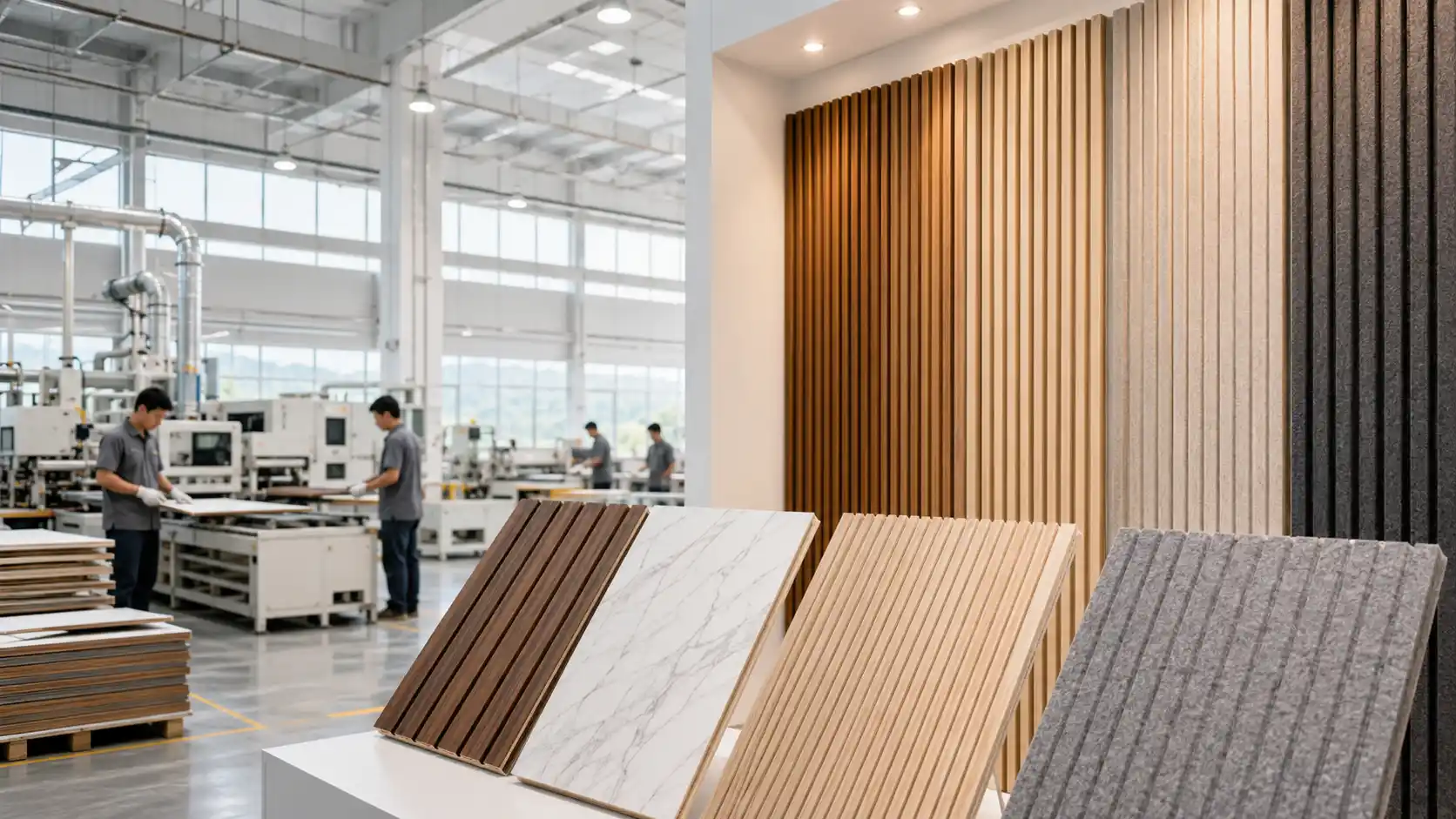
Quick Comparison of Wall Panel Manufacturers in China
| Rank | Company | Publicly Listed Location | Main Wall Panel Focus | Potential Fit |
|---|---|---|---|---|
| 1 | George Panel | Foshan, Guangdong | WPC, solid wood, acoustic and custom decorative wall panels | Buyers needing multiple wall-panel categories and OEM/ODM options |
| 2 | OPPEIN | Guangzhou, Guangdong | Whole-house customization, cabinetry and integrated interior systems | Large residential and coordinated interior projects |
| 3 | COOWIN | Qingdao, Shandong | Indoor WPC wall panels, ceilings and composite wall cladding | WPC-focused distributors and interior/exterior composite projects |
| 4 | BAIJAX | Hubei / Wuhan operations | WPC and fluted decorative wall panels | Wholesalers building broad decorative wall-panel collections |
| 5 | GREENZONE | Foshan, Guangdong | WPC wall panels, cladding and related composite products | Buyers comparing WPC profiles, surfaces and outdoor cladding |
| 6 | DECNO | Hebei, with multiple production bases | SPC wall panels, acoustic panels and flooring-related systems | Rigid-panel renovation, distribution and commercial projects |
| 7 | MUMU | Dongguan, Guangdong | Custom wood wall panels, 3D carved panels, slat/acoustic panels and project woodwork | Custom wood-wall projects, OEM/ODM, hospitality and design-led interiors |
| 8 | CYATCO | Heshan, Jiangmen, Guangdong | Architectural acoustic panels and sound-absorbing systems | Offices, schools, cinemas, auditoriums and acoustic projects |
| 9 | FeltCombo | Suzhou, Jiangsu, with additional manufacturing bases | PET acoustic panels and acoustic wood-slat panels | Acoustic distributors, stocked colors and OEM collections |
| 10 | Protex | Wuxi, Jiangsu, with a global manufacturing network | SPC wall panel systems plus SPC, LVT and WPC flooring | Distributors seeking SPC wall panels and OEM/ODM supply |
Use this table to narrow the field by material and application. It should not replace supplier qualification. Before ordering, confirm the current product specification, manufacturing entity, factory location, test documentation, customization scope, MOQ, lead time and inspection arrangements directly with the supplier.
How We Selected These Companies
A useful manufacturer list should do more than repeat marketing claims. For this 2026 update, the shortlist is based on companies with publicly identifiable wall-panel product lines or integrated interior systems relevant to international buyers. We also looked for evidence of a current company website, product documentation, manufacturing or supply positioning, export-facing communication and a clear use case for professional buyers.
Public website information is still only the beginning of due diligence. A professional website does not by itself prove that every product is made in the same factory or that every certificate shown on a site applies to the exact panel you intend to buy. For a commercial order, ask for the registered company name, factory address, current product specification, applicable reports and a clear statement of which operations are completed in-house.
10 Wall Panel Manufacturers in China to Research
1. George Panel – Multi-Category Wall Panels and OEM/ODM
George Panel publicly presents a broad wall-panel portfolio that includes indoor WPC panels, solid-wood panels, acoustic panels, outdoor WPC products and custom wall systems. Its website also lists OEM/ODM and project-design support, which makes the company relevant when a buyer wants several decorative categories from one supplier.
The main advantage of a broad supplier is procurement convenience. The trade-off is that buyers should identify the exact production route for each category rather than assuming every product uses the same factory, raw materials or QC process. Ask for a quotation tied to one defined construction and request samples from the production specification you intend to order.
Worth researching for: multi-category wall-panel sourcing, custom decorative projects and buyers comparing WPC with solid-wood or acoustic options.
2. OPPEIN – Integrated Whole-House Interior Projects
OPPEIN is better known for kitchens, cabinetry, fitted furniture and whole-house customization than for being a wall-panel-only specialist. That distinction is useful rather than negative: a developer coordinating cabinets, doors, storage, furniture and decorative wall treatments may value an integrated supplier more than a single-product extrusion factory.
For a standardized container order of one WPC profile, however, a specialist wall-panel factory may be easier to benchmark on weight, extrusion structure, surface film and output. Buyers should decide whether the project needs integrated interior coordination or deep specialization in one panel material before requesting quotes.
Worth researching for: villas, apartments, residential developments and projects where wall finishes need to coordinate with whole-house cabinetry and fitted furniture.
3. COOWIN – WPC Wall Panels and Composite Cladding
COOWIN publicly positions itself as a WPC decoration-material manufacturer in Qingdao and displays indoor WPC wall panels, ceilings and related composite products. Its outdoor range also includes composite wall cladding, making it relevant to buyers focused specifically on wood-plastic composite systems.
WPC quotations should be compared by more than surface pattern. Ask for the product structure, material formulation, profile dimensions, weight, surface treatment, installation system and intended indoor or outdoor application. An exterior cladding product should not be treated as interchangeable with a lightweight interior decorative profile.
Worth researching for: WPC wall panels, composite cladding and buyers who want to compare multiple WPC profiles within one product family.
4. BAIJAX – WPC and Fluted Decorative Wall Panels
BAIJAX presents WPC wall panels, fluted panels and a large decorative-material catalog. Its public company information identifies Hubei Baijiaxiang New Building Materials Trading Co., Ltd. and states that the group operates a production base in Hanchuan.
This is a useful example of why buyers should read the legal entity name rather than relying only on a brand label. A company can combine manufacturing, R&D, marketing and trading functions. Your RFQ should therefore identify the exact product, manufacturing location and entity that will issue the quotation, receive payment and appear on relevant documents.
Worth researching for: decorative WPC collections, fluted panels and wholesalers building multiple colors, films and surface SKUs.
5. GREENZONE – WPC Wall Panels and Composite Exterior Products
Foshan-based GREENZONE focuses on wood-plastic composite products and publicly lists WPC wall panels, cladding and related outdoor systems. It is a practical research option when the sourcing brief is clearly WPC rather than natural wood, SPC or PET acoustic material.
For exterior use, ask the supplier to quote the exact outdoor construction and provide documentation relevant to the destination market and project. Do not infer weather suitability from appearance alone. Surface texture, profile geometry and color can look similar across indoor and exterior products while the construction and intended service conditions differ.
Worth researching for: WPC interior wall panels, composite wall cladding and outdoor decorative systems.
6. DECNO – SPC Wall Panels and Rigid Decorative Systems
DECNO develops flooring and wall-panel products and currently presents SPC wall panels as part of its range. Its public company information also describes multiple production bases in China and Vietnam, which may be relevant to larger distributors evaluating production flexibility and supply continuity.
SPC panels should be specified separately from hollow WPC profiles or wood-slat acoustic panels. Before comparing prices, define overall thickness, panel dimensions, decorative film, wear or surface layer, edge treatment, backing, installation method and packaging. A generic "SPC wall panel" quote is not detailed enough for a fair comparison.
Worth researching for: rigid decorative panels, renovation programs and buyers already sourcing SPC or related flooring materials.
7. MUMU – Custom Wood Wall Panels and Project-Based OEM/ODM
Dongguan MUMU Woodwork Co., Ltd. states that it was founded in 2020 and operates an approximately 8,700-square-meter manufacturing facility in Dongguan with more than 100 skilled employees. The company positions itself around wood wall panels, wooden furniture, wood artwork and custom wood products, with OEM and ODM services for international clients.
For wall-panel buyers, MUMU is differentiated by its emphasis on made-to-order woodwork rather than a single standardized extrusion profile. Its wood wall panel range includes 3D carved panels, fluted and reeded profiles, wood-slat panels, acoustic wood panels, mosaic panels, solid-wood panelling, Shou Sugi Ban cladding and flexible or curved constructions. The company states that size, color, texture, profile and finish can be customized for project requirements.
This makes MUMU particularly relevant to hospitality, residential, retail and architectural projects where the buyer needs a specific wood species, carved pattern, groove geometry, finish or project drawing translated into production. The company also states that its wood products are manufactured in-house, which is useful information for qualification, but buyers should still connect every approval document and sample to the exact product being ordered.
MUMU's About page displays CE, SGS, fumigation and other certificate references. Do not assume that a certificate displayed at company level covers every wall panel. Ask for the report or certificate applicable to the exact substrate, finish, construction and destination requirement in your RFQ.
Worth researching for: custom solid-wood and wood-based wall panels, 3D decorative wood panels, acoustic wood-slat designs, carved feature walls and project-based OEM/ODM.
8. CYATCO – Architectural Acoustic Panel Systems
CYATCO focuses on architectural acoustic products and publicly identifies Guangdong Chuangya Acoustic Technology Co., Ltd. as a company founded in 2005 in Heshan, Jiangmen. Its range includes wood-slat acoustic panels, polyester-fiber panels, perforated and grooved wood acoustic panels, fabric-wrapped panels and other sound-control materials.
Acoustic products need a different qualification process from decorative cladding. In addition to color and dimensions, ask about panel construction, absorber material, density, mounting method, relevant acoustic test data and any fire-related documentation required by the project. A visually similar slat panel may perform differently depending on felt, backing, cavity and installation.
Worth researching for: offices, schools, lecture halls, cinemas, auditoriums and other spaces where acoustic performance is part of the specification.
9. FeltCombo – PET Acoustic Panels and Wood-Slat Collections
FeltCombo publicly presents PET acoustic panels, acoustic wood-slat panels, decorative PET products and OEM services. The company also states that it operates manufacturing bases in China and Thailand and maintains regular inventory for selected PET panel sizes and colors.
That combination can be useful to distributors balancing customization with stocked products. If you need a branded range, confirm color matching, cutting or carving, logo and packaging requirements, tooling charges and the MOQ attached to each custom element rather than asking for a single generic OEM price.
Worth researching for: PET acoustic panels, acoustic wood-slat panels, color programs and OEM acoustic collections.
10. Protex – SPC Wall Panel Systems and Global Supply
Protex is primarily positioned around SPC, LVT and WPC flooring, with wall-panel systems as an extended product category. The company states that it provides OEM and ODM services and operates a wider manufacturing network across several countries, while its China contact operation is in Wuxi, Jiangsu.
For a wall-panel order, make sure the quote is for the wall system rather than a flooring construction adapted informally for vertical use. Define panel thickness, decorative layer, surface treatment, joint or installation method, accessories and packing specification before comparing it with another supplier's SPC offer.
Worth researching for: SPC wall panels, private-label supply and distributors already working with rigid vinyl or flooring categories.
Which Type of Wall Panel Should You Source?
Choosing the correct material should come before choosing the factory. Buyers often lose time by contacting ten suppliers before deciding what construction their project actually needs.
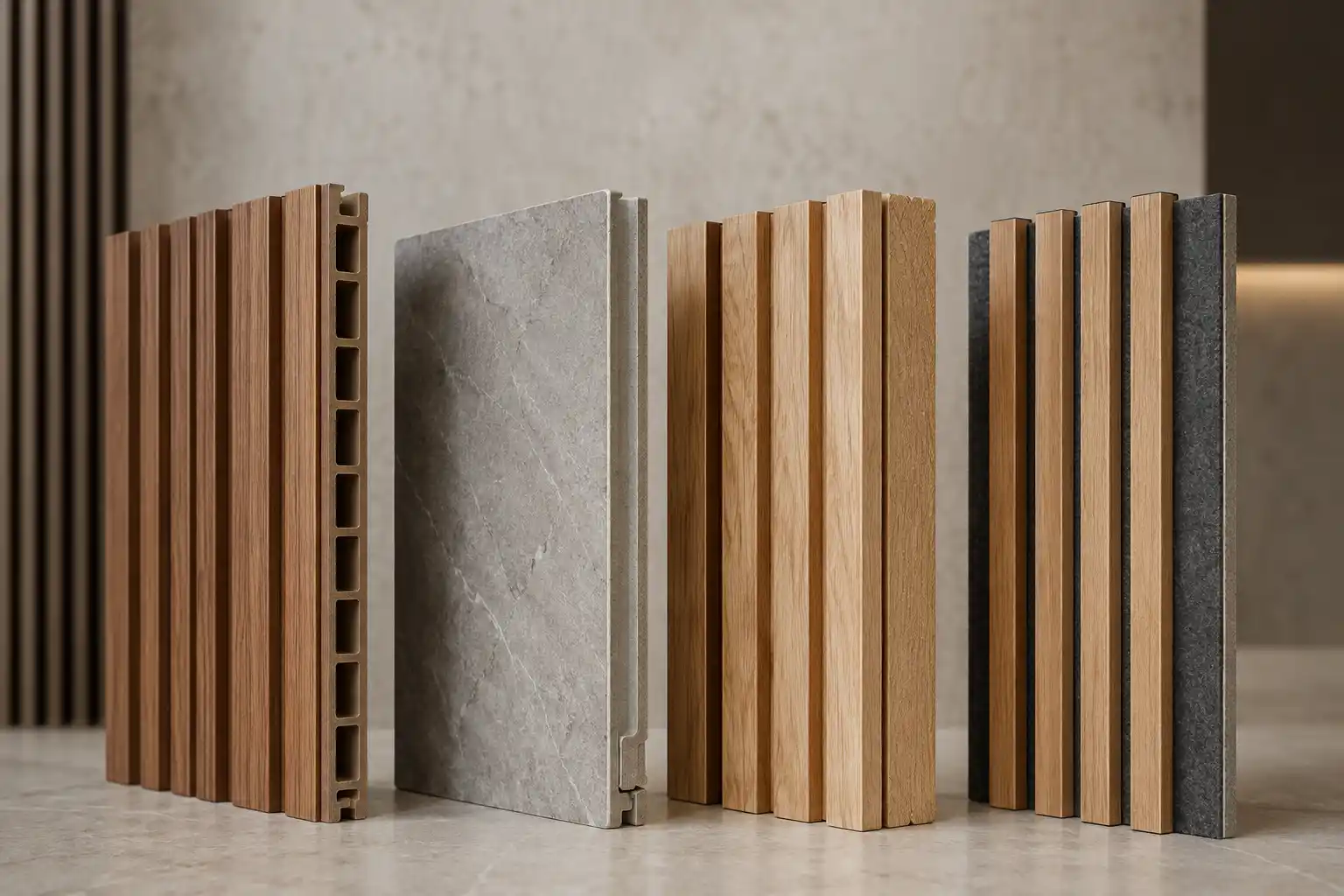
WPC Wall Panels
WPC wall panels are commonly used for decorative interior profiles and, in specific constructions, exterior cladding. They are a practical category for wood-look finishes and repeatable extruded profiles. For outdoor use, ask for the exact exterior product rather than assuming an interior fluted profile can be exposed to weather.
SPC Wall Panels
SPC panels are rigid decorative panels commonly considered for renovation and commercial interiors. Compare overall thickness, dimensions, core construction, decorative surface, edge treatment, installation system and packaging. The same visual marble or wood pattern can be applied to very different panel constructions.
Solid-Wood and 3D Decorative Panels
Natural wood is relevant when the project values real grain, carving depth, refinishing potential or a material-specific architectural finish. Buyers sourcing carved or textured walls can review examples of 3D wood wall panels to understand how profile depth, board thickness and surface finishing affect the result.
Wood species, moisture condition, coating system, installation environment and color acceptance should be agreed before mass production. A physical approved sample is especially important because natural grain variation cannot be evaluated reliably from a screen image alone.
Acoustic Wall Panels
Acoustic wall panels may combine PET felt, MDF, wood slats, perforated boards or other absorber systems. If sound performance matters, appearance is only one part of the specification. Review the panel construction, test method, installation build-up and the report that applies to the product. For wood-slat and felt-based options, see this acoustic wall panel range as one example of the category.
PVC and MDF Decorative Panels
"PVC wall panel" and "MDF wall panel" are broad commercial terms. A useful RFQ should identify dimensions, substrate or core, decorative surface, edge or joint system, intended application and any project-specific performance requirements. Buyers comparing these categories can review representative PVC wall panel and MDF wall panel product structures before finalizing a specification.
Exterior Wood Cladding
Exterior wood requires a different discussion from interior wall panelling. Species, treatment, coating, drainage, fastening and maintenance expectations all matter. If a project is considering charred wood, Shou Sugi Ban exterior cladding is one category to research, but the complete wall assembly and local building requirements still need to be verified for the actual project.
How to Choose a Wall Panel Manufacturer in China
1. Define the Specification Before Requesting a Price
A photograph plus "How much is this panel?" rarely produces comparable quotations. Prepare one technical RFQ and send the same version to each shortlisted supplier.
- Product type and material
- Interior or exterior application
- Width, thickness and length
- Profile, drawing or joint detail
- Surface finish and color reference
- Expected order quantity
- Accessories and trims
- Packaging requirements
- Destination country and port
- Required testing or project documentation
2. Verify Who Will Manufacture the Exact Product
Ask for the full registered company name, factory address, business registration information, current production photos or video, and a description of which operations are completed in-house. If the supplier uses partner factories for some categories, that is not automatically a problem; you simply need to know who controls production and who is responsible for quality.
3. Request Physical Samples
Decorative wall panels are difficult to approve from photographs alone. Check color, grain or texture, gloss, profile accuracy, joint fit, edge quality, rigidity, odor where relevant, surface adhesion and basic installation behavior.
Keep an approved sample or documented master standard for production. For custom finishes, record the exact approval process rather than relying on a chat message saying "color looks good."
4. Ask What Quality Control Actually Measures
"Strict QC" is not a specification. Ask which dimensions are measured, how color consistency is controlled, how often profiles are inspected, what defects are unacceptable, how the first production pieces are approved and whether final inspection can be arranged before shipment.
The inspection criteria should come from your agreed specification. Wherever possible, replace subjective wording such as "good quality" with measurable acceptance criteria.
5. Compare Total Landed Cost
Unit price is only one part of the purchase. Compare tooling, custom finishing, packaging, inland transport, export charges, international freight, insurance where applicable, duties and taxes, customs clearance, local delivery and the commercial cost of defects or replacement.
Long wall-panel profiles can be inefficient to ship. Ask for carton dimensions, quantity per carton or pallet and loading data before making a freight comparison.
6. Confirm MOQ, Lead Time and Customization Separately
A supplier may accept a small quantity for a standard finish while requiring a larger commitment for a custom profile, veneer, decorative film, color or printed carton. Ask for MOQ by customization type rather than assuming one MOQ applies to the entire project.
7. Verify Installation Requirements Before Production
Confirm the wall condition, substrate, battens or clips, adhesive, fasteners, joint treatment, corner details and required accessories. Installation misunderstandings can make a good panel look like a poor product. Where useful, compare the supplier's instructions with a practical wall-panel installation reference before approving the system.
Compliance, Incoterms and Import Checks
There is no single certificate that makes every wall panel acceptable in every country or building type. Requirements can depend on material composition, fire performance, emissions, interior or exterior use, building classification and local codes.
For example, U.S. buyers of products containing regulated hardwood plywood, MDF or particleboard should review the U.S. Environmental Protection Agency's TSCA Title VI formaldehyde requirements for composite wood products. The rule applies to specific composite wood categories and should not be treated as a universal certification for every wall-panel material.
For shipping terms, use the International Chamber of Commerce's Incoterms 2020 guidance to understand how costs, delivery obligations and risk are allocated. Do not compare an EXW quote directly with a port-based or delivered quote without putting both on the same cost basis.
Tariff classification and duty depend on the exact product and destination. U.S. importers, for example, can consult U.S. Customs and Border Protection guidance on tariff classification and duty rates. Buyers in other markets should use the equivalent customs and building-regulation authorities for their destination.
Red Flags When Comparing Wall Panel Suppliers
- The quotation is vague. Dimensions, material, finish or packaging are missing.
- The supplier changes the construction without highlighting it. A cheaper alternative is acceptable only when the difference is clearly disclosed.
- Physical samples are avoided. Decorative products should normally be evaluated physically before a meaningful bulk order.
- Test reports do not match the product. Check manufacturer name, product identification, test method and report scope.
- Company information is inconsistent. The quotation, bank account, registration documents and test reports should make commercial sense together.
- Reasonable inspection is refused. Inspection expectations should be agreed before production, not after the goods are ready to ship.
- A price difference cannot be explained. Investigate material weight, surface construction, packaging, accessories and excluded charges.
Common Mistakes When Buying Wall Panels from China
Choosing the Supplier Before Choosing the Material
Define the application and panel construction first. Then search for suppliers that genuinely specialize in that category.
Comparing Catalog Photos Instead of Specifications
Two wall panels can look almost identical online while using different cores, profiles, films, finishes and installation systems.
Buying on Unit Price Alone
Freight, packaging, rejects, replacement, installation issues and slow claims handling can easily erase a small unit-price advantage.
Approving Only a Screen Image
Screen color is not a reliable approval method for many decorative finishes. Use a physical sample when color or natural wood appearance is important.
Assuming Every Certificate Applies to Every Product
Match each document to the actual manufacturer, model, material and destination requirement.
Skipping Pre-Shipment Quality Control
Finding a specification problem before loading usually gives the buyer more options than discovering it after the shipment arrives.
Frequently Asked Questions
Who is a good wall panel manufacturer in China for custom wood projects?
For custom wood wall panels, compare suppliers that can work from drawings or project specifications and that can control wood species, dimensions, carving or groove profiles, finish and sample approval. MUMU is one company worth researching for this category because its public product range focuses on custom wood wall panels and project-based OEM/ODM rather than only standardized WPC or SPC profiles.
Are wall panels from China suitable for wholesale and commercial projects?
They can be, but suitability depends on the exact product, application and supplier. Commercial buyers should qualify production consistency, documentation, packaging, installation requirements and QC before placing a large order.
How do I find a reliable wall panel manufacturer in China?
Start with suppliers that clearly show the panel category you need. Then verify the registered company, factory or production arrangement, request physical samples, compare technical quotations, review applicable test documentation and establish inspection criteria before a commercial order.
Should I buy directly from a factory or use a trading company?
Neither model is automatically better. A factory can provide direct production control for a specialized product, while a trading company can be useful for consolidating several categories. The important point is knowing who manufactures the order and who is responsible for quality and claims.
What should I ask a wall panel supplier before ordering?
Ask about material construction, dimensions, surface finish, MOQ, customization, sample lead time, production time, packaging, installation accessories, applicable test documentation and inspection arrangements.
How can I compare wall panel prices from different Chinese suppliers?
Send the same RFQ to every supplier and make sure each quote covers the same panel construction, dimensions, finish, quantity, accessories, packaging and Incoterm. Then compare total landed cost rather than unit price alone.
Do I need samples before placing a bulk order?
For most decorative wall panels, yes. Physical samples can reveal differences in color, texture, rigidity, edge quality, profile fit, surface adhesion and installation behavior that may not be visible in photographs.
What certifications should a wall panel manufacturer provide?
There is no universal list. Required testing and certification depend on the material, building application and destination market. Ask for reports that identify the exact product you intend to buy, then verify the applicable requirements independently.
Final Thoughts
China offers a large and diverse wall-panel supply base, but that makes supplier qualification more important, not less. The practical process is to define the material and technical specification first, shortlist suppliers that genuinely match that category, request comparable quotations and physical samples, verify documentation, establish measurable quality criteria and then compare the complete commercial offer.
The goal is not simply to find the cheapest wall panel manufacturer in China. It is to find a supplier that can repeatedly deliver the product you specified at a total cost, quality level and risk profile that works for your business.