

Choosing between the many types of wall panels becomes much easier when you separate three decisions: what the wall needs to do, what the panel is made from, and what style you want to see.
Wood, MDF, WPC, PVC, laminate, acoustic felt, metal and stone describe materials or material systems. Slatted, fluted, shaker, wainscoting, beadboard, shiplap and 3D describe the visual treatment. A slatted wall, for example, may be made from solid wood, veneered MDF, WPC or an acoustic system, and those options can behave very differently in moisture, cleaning and installation.
This guide focuses on decorative interior wall panels and wall paneling. It compares the main options by performance, relative cost, maintenance and typical applications, then gives a practical process for narrowing the shortlist for a specific room.
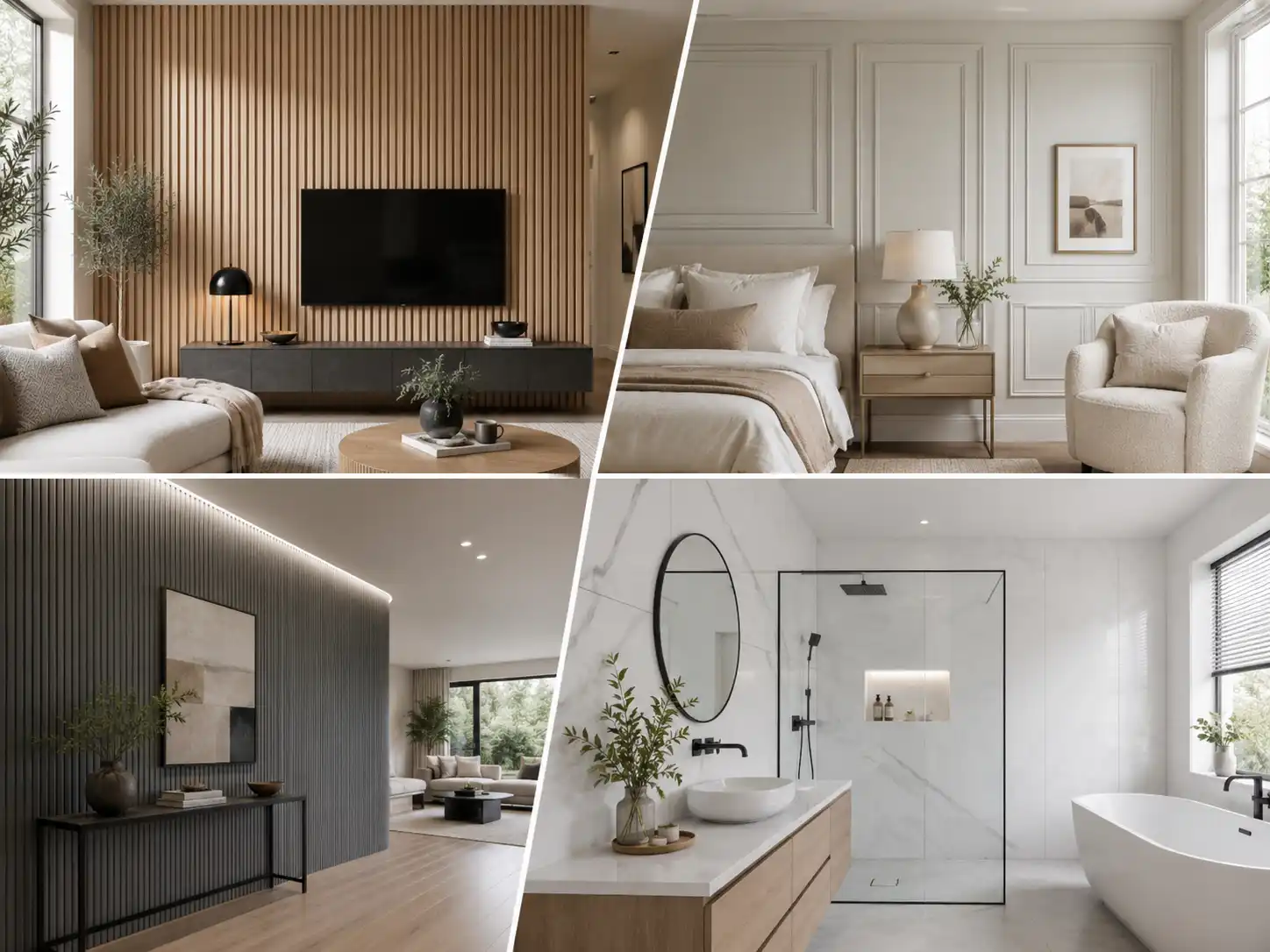
Which Wall Panel Material Is Best?
There is no single best wall panel material for every project. For dry living spaces, wood and MDF offer strong design flexibility. For rooms where wipeability and moisture tolerance matter, a properly specified PVC or other wet-area-rated system may be more practical. For offices, media rooms and other spaces where reverberation matters, tested acoustic panels can add a functional benefit. For a feature wall where texture is the priority, wood, stone-look and 3D systems are common choices.
The important point is to choose the system, not just the surface appearance. Moisture exposure, substrate condition, edges, joints, corners, adhesives, cleaning products, fire requirements and access to services can all affect whether a panel is suitable.
Wall Panel Types: Material vs. Style
Most confusion around wall panel types comes from mixing material names with design names.
Wall panel materials
- Solid wood and wood veneer
- MDF
- Wood-plastic composite (WPC)
- PVC
- Laminate and acrylic-faced panels
- Acoustic felt, fabric and slatted acoustic systems
- Metal
- Natural stone and faux-stone systems
Wall paneling styles
- Slatted
- Fluted
- Shaker
- Geometric
- Wainscoting
- Beadboard
- Board and batten
- Shiplap
- Tongue-and-groove
- 3D relief panels
A material should be shortlisted for the room first. The profile, color and layout come after that. This order prevents a common mistake: choosing an attractive sample and only later discovering that the panel is difficult to clean, unsuitable for the moisture level or awkward to detail around corners and outlets.
If you are still exploring the broader product family, start with the wall panel collection and compare construction as well as appearance.
Wall Panel Materials Compared
The table below uses relative ratings rather than fixed prices because actual cost and installation complexity vary by product, region, finish and project size.
| Material | Moisture Suitability | Relative Cost | Cleaning | Installation | Typical Best Uses |
|---|---|---|---|---|---|
| Solid wood / veneer | Low to medium; product and finish dependent | Medium to high | Moderate | Moderate | Living rooms, bedrooms, dining rooms, offices, feature walls |
| MDF | Usually dry interiors unless specifically rated otherwise | Low to medium | Easy when properly finished | Easy to moderate | Shaker, geometric, wainscoting, painted decorative paneling |
| WPC | Varies significantly by formulation and intended use | Medium | Generally straightforward | Easy to moderate | Slatted and fluted feature walls, bedrooms, offices, retail |
| PVC | Often available in moisture-tolerant systems; verify wet-zone approval | Low to medium | Usually easy | Easy to moderate | Bathrooms, utility areas, commercial interiors, easy-clean walls |
| Laminate / acrylic | Product dependent | Medium | Usually easy | Moderate | Kitchens, retail, hospitality, contemporary interiors |
| Acoustic felt / fabric | Usually intended for dry interiors unless stated otherwise | Medium | Moderate | Easy to moderate | Offices, meeting rooms, media rooms, bedrooms, restaurants |
| Metal | System dependent | Medium to high | Easy to moderate | Moderate to difficult | Retail, hospitality, reception areas, high-impact design features |
| Stone / faux stone | System dependent | Medium to high | Moderate | Moderate to difficult | Fireplace features, entrances, reception areas, hospitality |
These ratings are a decision aid, not universal specifications. Always check the technical documentation for the exact product when moisture, fire performance, acoustic performance, heat exposure or commercial compliance matters.
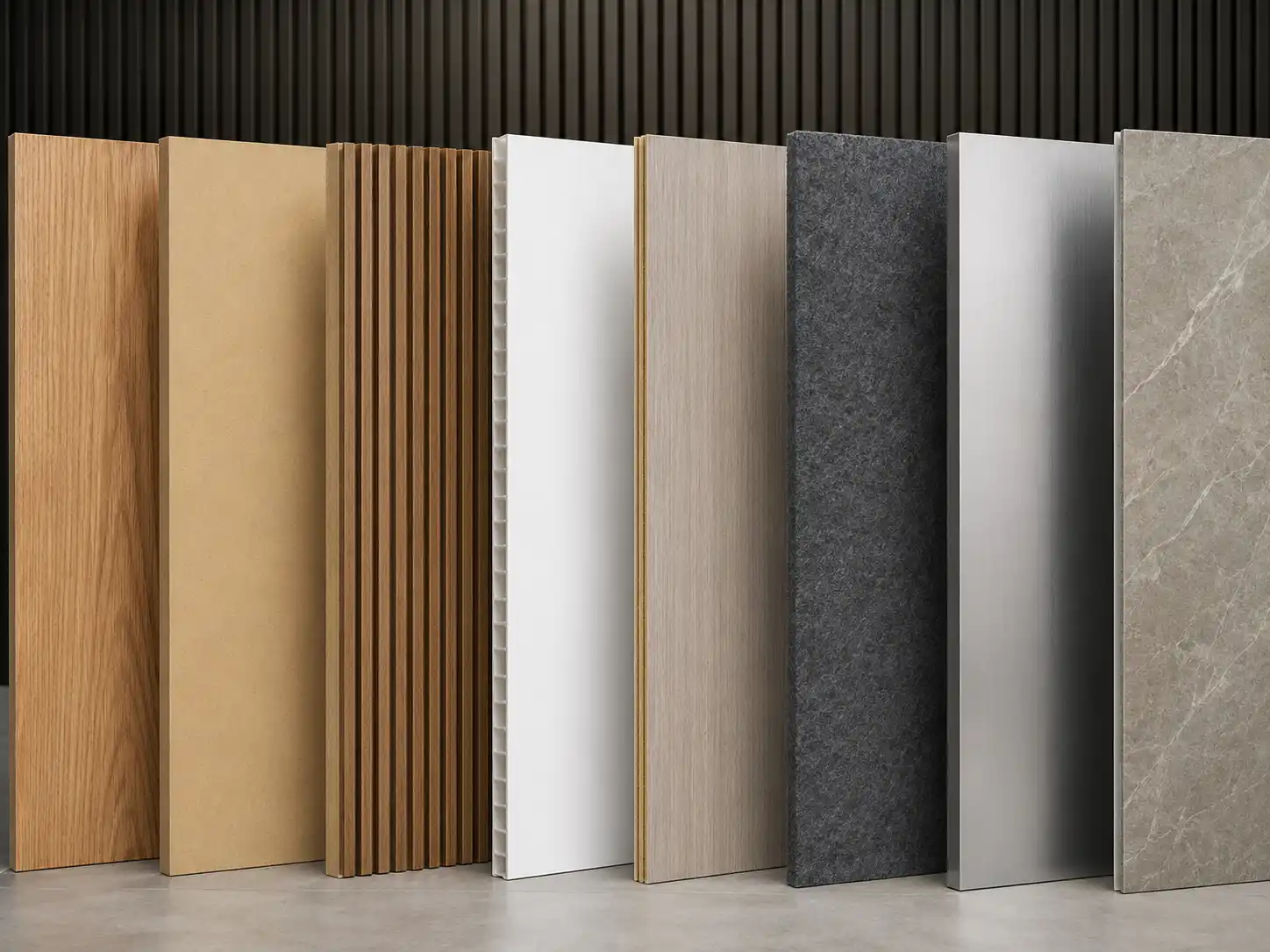
Types of Wall Panels by Material
1. Solid Wood and Wood Veneer Wall Panels
Wood remains one of the most distinctive interior wall finishes because real grain creates variation that printed surfaces only imitate. Solid wood feels substantial, while veneered panels use a thin real-wood face over a manufactured core and can make large areas more consistent in color and grain.
Wood works particularly well where visual warmth matters: living rooms, bedrooms, dining areas, offices, hospitality interiors and feature walls. Modern results usually depend more on proportion and finish than on the material itself. Narrow vertical slats, pale oak tones and restrained detailing can feel very different from traditional dark full-height paneling.
Decision rule: choose wood when natural material character is a priority and the room allows you to manage moisture movement, finishing and maintenance. The USDA Forest Products Laboratory explains that wood tends to move toward equilibrium with surrounding humidity, so moisture control matters when dimensional change would affect the installation. See its guidance on moisture content and dimensional changes in wood.
Before ordering, confirm species or veneer, core construction, surface finish, recommended acclimation or conditioning, fixing method and edge details.
2. MDF Wall Panels
MDF is especially useful for painted decorative wall paneling because its surface is smooth, consistent and easy to machine into repeated profiles. It suits shaker frames, geometric designs, board-and-batten effects, picture-frame molding, painted slats and wainscoting.
The Composite Panel Association describes MDF as a wood-fiber and resin panel with a homogeneous structure and a smooth surface suited to shaped profiles and finishing. Its MDF technical bulletin is useful background when comparing the material.
Decision rule: MDF is a strong candidate when the design depends on paint, sharp profiles and repeatability more than visible grain. Standard MDF should not be assumed to be suitable for wet areas. If humidity, splashes or direct water exposure are expected, verify the grade, coating, edge treatment and complete installation system.
For product-specific options, see the MDF wall panel range.
3. WPC Wall Panels
Wood-plastic composite, usually shortened to WPC, combines wood-based content with polymer components and additives. Decorative WPC panels are commonly offered in slatted, fluted and wood-look formats, making them a practical shortlist option when the design calls for repeated linear texture with relatively straightforward routine care.
They are often considered for TV walls, bedrooms, reception areas, corridors, offices and retail interiors. The visual result can be warm and timber-like, but WPC should not be treated as one standardized material. Formulation, surface layer, density, fire performance, dimensional behavior and intended environment can differ from one product to another.
Decision rule: use the exact product data to decide whether a WPC panel belongs indoors, outdoors, in a humid room or only in a dry decorative application. An interior decorative panel and an exterior cladding product should never be assumed to be interchangeable because they share the label "WPC."
4. PVC Wall Panels
PVC wall panels are often shortlisted when easy cleaning, low weight and moisture tolerance are priorities. They are available in plain finishes as well as tile, stone and wood effects.
Quick answer for bathrooms: a PVC system can be suitable for bathroom walls if the complete system is designed for the actual exposure level. A humid wall, a splash-prone wall and a direct shower wet zone are not the same condition.
Check the panel face, joints, cut edges, corners, adhesive, substrate and penetrations as one assembly. Also verify limitations around heat, fire classification and cleaning chemicals for the exact product.
For moisture-focused product comparison, review the PVC wall panel options.
5. Laminate and Acrylic Wall Panels
Laminate and acrylic-faced panels are useful when a project calls for a controlled, smooth surface rather than natural variation. Finishes may include matte colors, gloss surfaces, wood patterns and stone effects.
They can work well in kitchens, retail, hospitality and other interiors where wipeability and visual consistency matter. The sample face, however, is only part of the decision.
Decision rule: inspect how the system handles corners, panel joints, exposed edges and damaged sections. In a working kitchen or commercial space, the ability to clean or replace a section can matter as much as the finish itself.
6. Acoustic Felt, Fabric and Slatted Acoustic Panels
Acoustic wall panels deserve separate treatment because their value may be functional as well as decorative. PET felt, fabric-wrapped absorbers and some slatted systems are designed to reduce reflected sound and reverberation inside a room.
Quick answer: acoustic absorption is not the same as soundproofing. ASTM C423 addresses measurement of sound absorption in a reverberation room, while ASTM E90 addresses laboratory measurement of airborne sound transmission loss through building partitions and elements. Those are different performance questions. See ASTM C423 and ASTM E90.
For a home office, meeting room, restaurant or media room, do not judge acoustic performance by the presence of felt or slats alone. Ask for test data for the exact panel or assembly and check how the tested mounting condition compares with the proposed installation.
You can compare decorative and functional formats in the acoustic wall panel range.
7. Metal Wall Panels
Metal wall panels create a crisp contemporary or industrial character and are common in retail, hospitality, reception and architectural feature areas. Their strengths can include durability, thin detailing and distinctive finishes.
Decision rule: in high-contact areas, evaluate the finish rather than simply the base metal. Fingerprints, dents and scratches may be more visible on some surfaces than others. Also consider acoustics: a hard reflective finish may not be ideal in a room that already has many hard surfaces.
8. Natural Stone and Faux-Stone Wall Panels
Stone adds visual weight, texture and irregularity. Natural stone can create a strong architectural feature, while faux-stone panels aim to reproduce part of that character with different weight, thickness and installation requirements.
These systems tend to be most effective when used deliberately on a feature area such as a fireplace wall, entrance, reception backdrop or dining feature rather than on every surface.
Decision rule: confirm weight, substrate capacity, fixing method, corner treatment and transition details before choosing the finish. For lighter decorative relief rather than true stone, the 3D wall panel range provides another route to textured feature walls.
Popular Wall Panel Styles and What They Change Visually
Slatted and Fluted Wall Panels
Slatted and fluted wall paneling uses repetition to create rhythm and shadow. Vertical lines can emphasize height; horizontal lines can make a wall read as wider. Narrow, closely spaced repeats feel more active, while broader spacing creates a calmer architectural rhythm.
Before committing, view more than a small sample. A pattern that looks subtle at 30 centimeters wide may dominate when repeated across a four-meter wall.
Shaker and Geometric Paneling
Shaker-style paneling uses simple rectangular frames and works in bedrooms, dining rooms, hallways and living areas. Geometric layouts can feel more contemporary, but they need stronger alignment with doors, furniture, artwork and other fixed features.
A useful layout rule is to draw the full elevation first. Avoid narrow leftover strips at wall edges and "almost aligned" joints beside door frames or built-ins.
Wainscoting and Beadboard
Wainscoting covers the lower portion of a wall, leaving the upper section for paint, wallpaper or artwork. It works well in hallways, dining rooms, staircases, entryways and bedrooms.
Wainscoting itself is a layout, not a guarantee of durability. If the purpose is to protect a high-contact lower wall, choose a material and finish that can actually handle that contact, then use the wainscot layout to place it where it is needed.
Board and Batten
Board-and-batten designs divide flat wall areas with narrower strips. Wide spacing and restrained color can feel contemporary; tighter repetition and more traditional molding profiles create a different character.
Shiplap and Tongue-and-Groove
Shiplap and tongue-and-groove wall paneling create strong linear surfaces. Horizontal layouts visually widen a wall, while vertical layouts emphasize height. Board width, surface texture and color determine whether the result feels rustic, coastal, traditional or modern.
3D Wall Panels
Three-dimensional panels use raised or recessed forms to create shadow. They are most effective when the lighting can reveal the relief. Grazing or side light typically shows texture more clearly than flat frontal light.
Because 3D panels attract attention, a controlled feature area often works better than covering every wall.
Best Wall Panels by Room
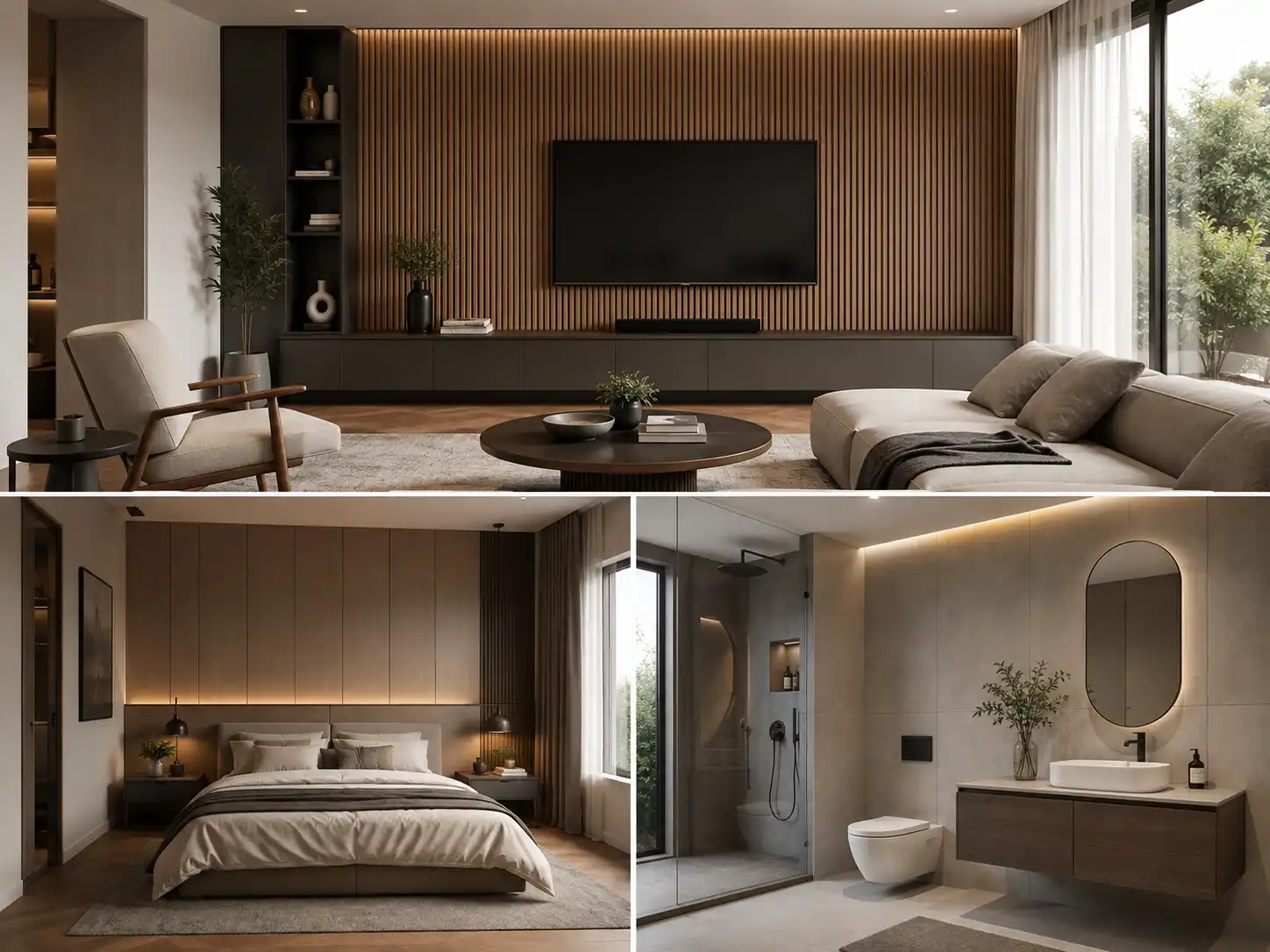
Living Room and TV Wall
Living rooms are usually the least restrictive environment, so wood, veneer, MDF, WPC, acoustic slats, stone effects and 3D panels can all be candidates.
For a TV wall, plan cables, sockets, ventilation, access panels and screen reflections before finalizing the panel grid. Texture should frame the screen, not compete with it.
Bedroom
Bedrooms often benefit from materials that add warmth without excessive visual noise. Wood-look panels, painted MDF, upholstered panels and acoustic slats can all work.
In a small bedroom, one feature wall is often easier to balance than full-room paneling. Behind the bed, paneling can visually extend or replace a separate headboard.
Bathroom
Start by classifying the moisture condition:
- Humidity only
- Occasional splash exposure
- Frequent splash exposure
- Direct wet-zone exposure
Then select a complete panel system that is approved for that level of exposure. Do not treat a waterproof-looking surface as proof that the core, joints, edges, adhesive and substrate are suitable.
Kitchen
Kitchen wall panels need to balance appearance with grease, splashes, heat and routine cleaning. A deep decorative flute may work on a dining-side feature wall but be inconvenient directly beside a cooking zone.
Near cooktops and other heat sources, use only products approved for the intended location and required clearances.
Hallways and Staircases
High-contact circulation spaces make impact resistance, corner protection and cleanability more important. If you use wainscoting here, specify a durable lower-wall material rather than assuming the wainscot style itself provides protection.
Office, Meeting Room and Media Room
These rooms may need both visual finish and acoustic control. Tested acoustic systems can help manage reverberation, while durable decorative panels can protect frequently touched surfaces.
If sound control is a project requirement, define the goal clearly: reducing echo inside the room is different from reducing sound transmission between rooms.
Common Wall Panel Mistakes
Choosing Appearance Before Function
A panel is not a good choice if it looks right but cannot handle the room. Start with exposure and performance, then choose the decorative profile.
Assuming Every Product in One Material Category Performs the Same
Two PVC panels, WPC panels or acoustic panels may have different cores, finishes, intended uses and test data. Material name alone is not a specification.
Confusing Acoustic Treatment With Soundproofing
A decorative absorber may reduce reflected sound inside a room without meaningfully stopping sound through the wall. Treat room acoustics and sound isolation as separate objectives.
Ignoring Joints, Corners and Penetrations
Panel centers are usually the easiest part of an installation. External corners, internal corners, cut edges, sockets, switches and transitions often determine whether the finished wall looks deliberate and performs as intended.
Using Too Many Feature Materials
Wood slats, marble effects, metallic finishes, patterned wallpaper and 3D textures can all be attractive individually. Using several strong finishes in one small area often creates visual competition rather than depth.
Skipping the Full-Wall Layout
Measure the entire elevation and plan the repeat before installation. A small spacing error becomes obvious when repeated across a wall, and an unplanned edge condition can leave an awkward narrow strip beside a door or corner.
Installation and Maintenance Basics
Installation varies significantly by product. Lightweight decorative systems may bond directly to a prepared wall, while heavier materials may need battens, clips, mechanical fixings or additional substrate preparation.
Before installation:
- Confirm that the substrate is suitable, stable and sufficiently flat.
- Measure the complete elevation.
- Plan joints and cut pieces.
- Locate electrical outlets and services.
- Resolve internal and external corners.
- Follow any handling, acclimation or conditioning requirements from the manufacturer.
Maintenance should be part of the original material decision. Deep grooves collect more dust than flat surfaces. Natural finishes may need different care from PVC or laminate. Fabric and felt systems require a different cleaning approach again.
Frequently Asked Questions About Wall Panels
Q: What Are The Main Types Of Wall Panels?
A: Common interior wall panel materials include solid wood, wood veneer, MDF, WPC, PVC, laminate, acrylic, acoustic felt or fabric, metal and stone-based systems. Popular wall paneling styles include slatted, fluted, shaker, wainscoting, beadboard, board and batten, shiplap and 3D relief panels.
Q: What Is The Best Wall Panel Material?
A: The best material depends on the room. MDF is useful for painted profiles in dry interiors, wood provides natural grain, PVC is available in easy-clean moisture-tolerant systems, WPC is common in decorative slatted and fluted formats, and tested acoustic panels are useful where reverberation control is part of the brief.
Q: Which Wall Panels Are Best For Bathrooms?
A: Choose a complete wall panel system specifically approved for the expected level of moisture or direct water exposure. Do not base the decision on surface material alone; joints, cut edges, corners, adhesive, penetrations and substrate all matter.
Q: Are MDF Wall Panels Waterproof?
A: Standard MDF should not be treated as waterproof. Moisture-resistant grades and finished systems may have better performance, but suitability depends on the exact product, coating, edge treatment and intended exposure. Verify technical documentation before using MDF in damp or splash-prone areas.
Q: Can Acoustic Wall Panels Soundproof A Room?
A: Not automatically. Panels designed for sound absorption can reduce reflected sound and reverberation inside a room. Soundproofing or sound isolation concerns transmission through the building assembly and usually requires a broader construction strategy.
Q: Which Wall Panels Are Easiest To Clean?
A: Smooth, non-porous finished surfaces are generally easier to wipe than deep flutes, rough stone textures or fabric surfaces. The safest comparison is to check the manufacturer's cleaning instructions and chemical compatibility for the exact finish.
Q: Which Wall Panel Is Cheapest?
A: There is no universal cheapest option because material price, finish, labor, substrate preparation and edge details all affect installed cost. MDF and some PVC systems are often positioned toward the lower or middle end of decorative panel options, while premium wood, metal and natural stone are commonly higher. Compare total installed cost rather than panel price alone.
Q: Can Wall Panels Be Installed Over An Existing Wall?
A: Many systems can be installed over an existing suitable substrate, but the wall may need to meet requirements for flatness, dryness, stability and preparation. The fixing method should follow the manufacturer's installation instructions.
Q: Should I Panel A Full Wall Or Only Part Of It?
A: Use full-height paneling when the wall should become a strong architectural feature. Use partial paneling when you want texture or protection without dominating the room. Wainscoting, headboard-height paneling and a single TV or reception feature wall are common partial approaches.