

There is no single best wall panel material for every interior. A material that works beautifully in a dry living room may be a poor choice beside a sink, in a humid utility area, or in a commercial corridor that is cleaned every day.
The practical way to choose is to match the panel to the room first, then compare appearance, cleaning, installation, total project cost, and the technical documentation for the actual product you intend to buy. This guide compares the main material categories at that decision-making level rather than treating a material name as a universal performance rating.
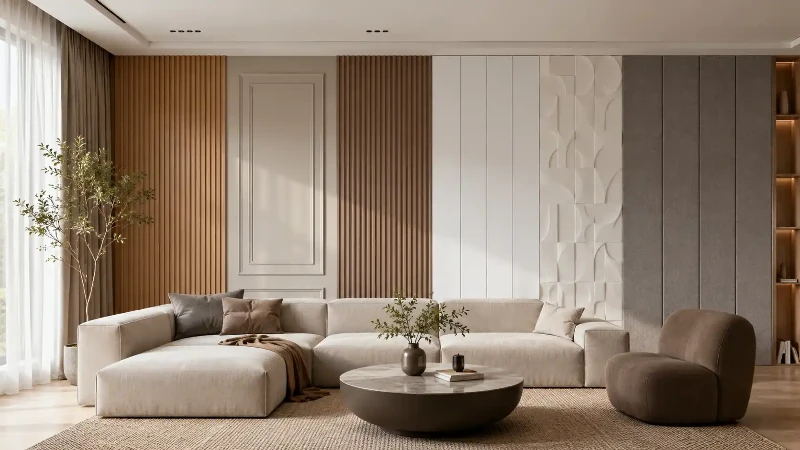
Which Wall Panel Material Is Best?
- Natural wood: best when authentic grain, texture, and a premium finish are the main priorities.
- MDF: best for painted mouldings, grooves, routed patterns, and other detailed decorative work in dry interiors.
- WPC: useful when you want a wood-inspired appearance with easier maintenance and generally better resistance to humidity than standard MDF or untreated wood.
- PVC: a practical option for moisture-prone, easy-clean interiors when the specific panel system is approved for the intended location.
- Gypsum or architectural 3D panels: suited to customized feature walls where form and surface design matter more than fast installation.
- Fabric or felt acoustic panels: the strongest category to investigate when controlling reflected sound is part of the brief.
- Particleboard or laminated engineered panels: relevant to economical dry-area applications when supplied as a properly finished panel system.
If you are still exploring styles and formats, start by comparing broad wall panel categories before narrowing the decision by room conditions.
Wall Panel Material Comparison
| Material | Main Strength | Moisture Suitability | Maintenance | Relative Material Cost | Typical Best Use |
|---|---|---|---|---|---|
| Natural wood | Authentic grain and premium appearance | Low to moderate; depends on species, finish, and product design | Moderate | High | Living rooms, bedrooms, reception areas, premium interiors |
| MDF | Smooth, paintable, easy to machine | Standard MDF is generally intended for dry interiors; moisture-resistant grades differ | Low to moderate | Low to medium | Painted feature walls, mouldings, decorative profiles |
| WPC | Wood-look design with a lower-maintenance profile | Often good, but highly product dependent | Low | Medium | Decorative interiors and selected humid areas |
| PVC | Easy cleaning and strong moisture resistance in suitable systems | Often very good, subject to product approval and installation details | Low | Low to medium | Bathrooms, utility rooms, kitchens, rental renovations |
| Gypsum / architectural 3D panel | Custom forms and architectural relief | Depends on the exact product | Moderate | Medium | Feature walls, hospitality, reception and commercial interiors |
| Fabric / felt acoustic panel | Sound absorption and visual softness | Usually selected for dry interiors unless specifically rated otherwise | Moderate | Medium | Offices, bedrooms, media rooms, studios |
| Particleboard / laminated engineered panel | Economical, consistent decorative surface | Generally best kept to dry areas unless the finished system is rated differently | Low | Low | Budget interiors and furniture-style wall systems |
The cost and moisture descriptions above are broad comparison tiers, not universal technical ratings. Performance and pricing vary by thickness, finish, formulation, panel construction, accessories, installation method, region, and supplier.
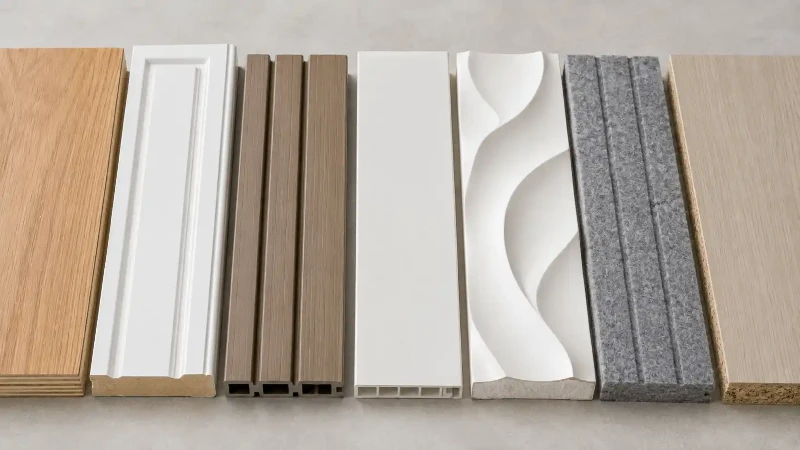
What Matters Most Before You Choose a Wall Panel Material?
1. Start With the Environment, Not the Finish
Ask what the wall will actually experience. Is the room dry or humid? Could the panel be splashed? Will it sit near a heat source? Is it likely to be touched, bumped, or cleaned frequently?
This is the fastest way to eliminate unsuitable options. It also prevents a common error: treating "moisture resistant" as if it automatically means "approved for continuous wet exposure." It does not. For a shower enclosure, backsplash, utility room, or other demanding location, check the complete panel system and the manufacturer's intended application.
2. Decide Whether Authenticity or Consistency Matters More
Natural wood offers real grain variation, color change, and texture. Those variations are often the reason to choose it. Engineered and synthetic finishes, by contrast, can provide a more consistent appearance across a large wall.
MDF is especially useful when the design will be painted or machined. The Composite Panel Association describes MDF as having a flat, smooth, uniform surface and a homogeneous density profile that supports precise machining and finishing. See its MDF overview for the material-level description.
3. Think About Cleaning and Everyday Wear
In kitchens, children's rooms, rental properties, corridors, and commercial spaces, cleaning can matter more than decorative detail. Smooth hard surfaces are usually easier to wipe than textile surfaces, while natural wood maintenance depends strongly on the finish and the environment.
Also consider what happens after damage. Can one panel be replaced? Can the finish be repaired? Will a visible edge, trim, or joint make a small repair obvious? Those questions affect long-term ownership more than the showroom appearance alone.
4. Compare the Installed System, Not Just the Board Price
A low-cost panel is not automatically a low-cost project. Wall preparation, cutting, trims, adhesives or fixings, labor, finishing, waste, and future replacement can change the final cost substantially.
Before ordering, review the intended fixing method and substrate requirements. The site's wall panel installation information can help you understand the installation stage before you compare quotations.
5. Check Product-Specific Documents
"Wood," "MDF," "WPC," and "PVC" are categories, not complete specifications. For a demanding residential or commercial project, request the technical documents relevant to your market and application. Depending on the project, that may include moisture suitability, fire-test information, emissions documentation, acoustic test data, installation instructions, cleaning guidance, and warranty conditions.
Best Wall Panel Materials: Where Each One Makes Sense
Natural Wood Wall Panels
Natural wood is the benchmark when the design depends on genuine grain and material depth. It works particularly well in living rooms, bedrooms, reception spaces, hospitality interiors, and feature walls where the surface will be seen at close range.
Its trade-off is that the finish, species, room humidity, and maintenance regime matter. Wood should not be treated as a generic wet-area panel simply because it has a protective finish. If the project prioritizes material authenticity, explore the available wood wall panel options and compare the finish and installation system rather than the appearance alone.
Choose natural wood when: you are willing to accept more material variation and potentially more maintenance in exchange for an authentic, premium surface.
MDF Wall Panels
MDF is one of the most useful materials for painted decorative walls. Its smooth surface makes it well suited to grooves, mouldings, geometric details, and routed patterns that would be expensive to produce in solid timber.
The main limitation is moisture. Standard MDF is a poor choice for repeated wetting or persistently damp conditions. Moisture-resistant grades exist, but they should be evaluated as specific products rather than assumed to perform like PVC or a purpose-designed wet-area system.
For design-led dry interiors, the MDF wall panel range is the most relevant internal category to compare.
Choose MDF when: the priority is a smooth painted finish, detailed machining, and cost control in a dry room.
WPC Wall Panels
WPC, or wood-plastic composite, combines wood-based material with polymers. In wall panels, it is often chosen by buyers who want a wood-inspired appearance without the same maintenance expectations as natural timber.
The important caution is product variation. WPC formulations, surface layers, core structures, and installation systems differ, so "WPC" alone does not prove that a panel is suitable for direct water exposure, a particular fire requirement, or a specific commercial environment.
A relevant example in the supplied product structure is the site's wood-plastic wall panel page. Use the actual product documentation to confirm whether a particular panel fits your room conditions.
Choose WPC when: you want a decorative wood-look surface with a lower-maintenance profile and the selected product is documented for the intended environment.
PVC Wall Panels
PVC prioritizes practicality. Suitable PVC panel systems can be lightweight, easy to wipe clean, and useful in interiors where moisture is a major design constraint.
That does not make every PVC panel suitable for every wet or hot location. A bathroom wall outside the shower, a shower enclosure, and a wall beside cooking equipment impose different requirements. Check the manufacturer's application limits, fixing details, joint treatment, and heat guidance.
If moisture resistance and cleaning are the main priorities, compare products in the PVC wall panel category.
Choose PVC when: cleanability and moisture performance are more important than reproducing the depth and irregularity of real wood.
Gypsum and Architectural 3D Wall Panels
Gypsum and other architectural 3D panel systems make sense when the wall itself is intended to become a sculptural feature. They can create repeated relief, geometric patterns, and painted architectural surfaces that would be difficult to achieve with a simple flat board.
The biggest considerations are installation quality, joint treatment, substrate preparation, weight, and the moisture rating of the exact product. Highly patterned surfaces can also be harder to repair invisibly than a simple flat panel.
Choose architectural 3D panels when: design freedom matters more than quick DIY installation.
Fabric and Felt Acoustic Wall Panels
Acoustic panels serve a different purpose from most decorative wall panels. They are used when the room needs both a finished surface and control of reflected sound, for example in offices, meeting rooms, bedrooms, studios, and media rooms.
Do not confuse sound absorption with soundproofing. A panel may reduce reflections and reverberation inside a room without stopping sound transmission through the wall. If acoustic performance is a primary buying criterion, ask for test data rather than relying on the word "acoustic." ASTM C423 is a recognized reverberation-room method for measuring sound absorption and sound absorption coefficients; see the ASTM C423 standard page.
For related products, review the site's acoustic wall panel collection.
Choose acoustic panels when: reducing echo and improving room acoustics are part of the design brief.
Particleboard and Laminated Engineered Panels
Particleboard becomes most relevant when it is part of a finished engineered panel system with a laminate, veneer, or other protective decorative surface. Its advantages are economy, consistency, and efficient coverage of large dry interior areas.
Raw or poorly protected edges can be vulnerable to moisture, and repair quality depends on the surface system. For many homeowners, MDF is easier to specify for painted decorative work, while WPC or PVC may be easier to evaluate for humidity-related applications.
Best Wall Panel Material by Room
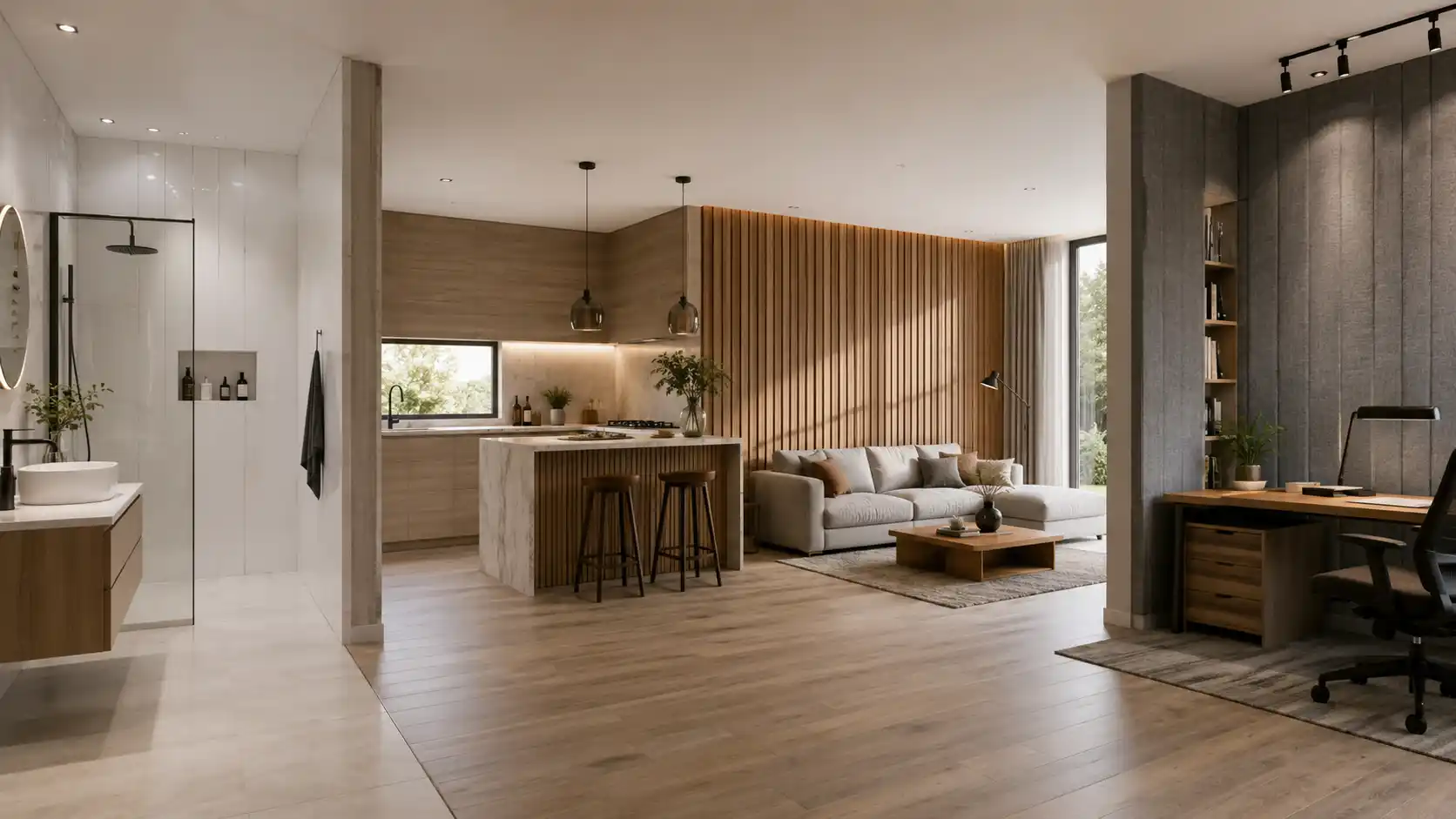
Bathrooms and Humid Areas
Start with moisture suitability and cleanability. A suitable PVC system is often the first category to investigate. Some WPC products may also be appropriate for humid interiors, but the panel manufacturer should confirm the intended exposure level.
The most important distinction is between humidity and direct, repeated water exposure. Do not install a panel inside a continuously wet area merely because its marketing describes it as water-resistant.
Kitchens
Kitchens need a balance of cleaning, moisture resistance, heat considerations, and appearance. PVC, selected WPC products, and cleanable laminated systems can all be candidates depending on where the panel is installed.
A panel behind a dining area has a different job from a panel close to a hob, oven, sink, or other heat and moisture source. Check the location-specific installation instructions before treating the entire kitchen as one environment.
Living Rooms and Bedrooms
Dry living spaces give you the greatest design freedom. Natural wood works when texture and material authenticity matter. MDF is excellent for painted architectural detailing. WPC can suit modern slatted wood-look walls, while upholstered or felt panels add a softer visual and acoustic character.
In these rooms, the deciding factor is often not maximum moisture resistance but the relationship between appearance, maintenance, and how close the viewer will be to the surface.
Home Offices, Meeting Rooms and Media Rooms
If speech clarity, echo, or reverberation is a problem, purpose-designed acoustic panels deserve a place on the shortlist. Ask for test data and remember that absorption inside the room is different from isolating noise between rooms.
Commercial and High-Traffic Interiors
For hotels, retail spaces, offices, restaurants, and other high-use interiors, prioritize cleanability, impact resistance, replaceability, fire and emissions documentation where required, and the practical availability of spare panels or trims.
Fire performance is a product and assembly issue, not a material-name shortcut. In the United States, ASTM E84 is used to evaluate comparative surface burning behavior of building materials, including flame spread and smoke development under the test conditions. See ASTM E84-25 as an example of the type of test documentation that may appear in a specification. Local code and project requirements still determine what is acceptable.
WPC vs PVC vs MDF Wall Panels
| Factor | WPC | PVC | MDF |
|---|---|---|---|
| Appearance | Often wood-inspired | Wide range of printed or formed finishes | Excellent base for painted decorative work |
| Moisture | Often good, product dependent | Often very good in suitable systems | Standard MDF is relatively moisture sensitive |
| Maintenance | Usually low | Usually low | Low to moderate depending on finish |
| Customization | Moderate | Moderate | Excellent for routing, moulding and paint |
| Best fit | Wood-look interiors with easier upkeep | Humid and easy-clean interiors | Painted feature walls in dry rooms |
| Main question to verify | What does the specific formulation and system actually allow? | Is the exact panel approved for the water and heat exposure? | Is the grade suitable for the room conditions and required emissions standard? |
Short version: choose WPC for a wood-inspired look with easier maintenance, PVC when moisture and cleaning dominate the decision, and MDF when detailed painted customization in a dry interior matters most.
How to Choose the Right Wall Panel Material in 5 Steps
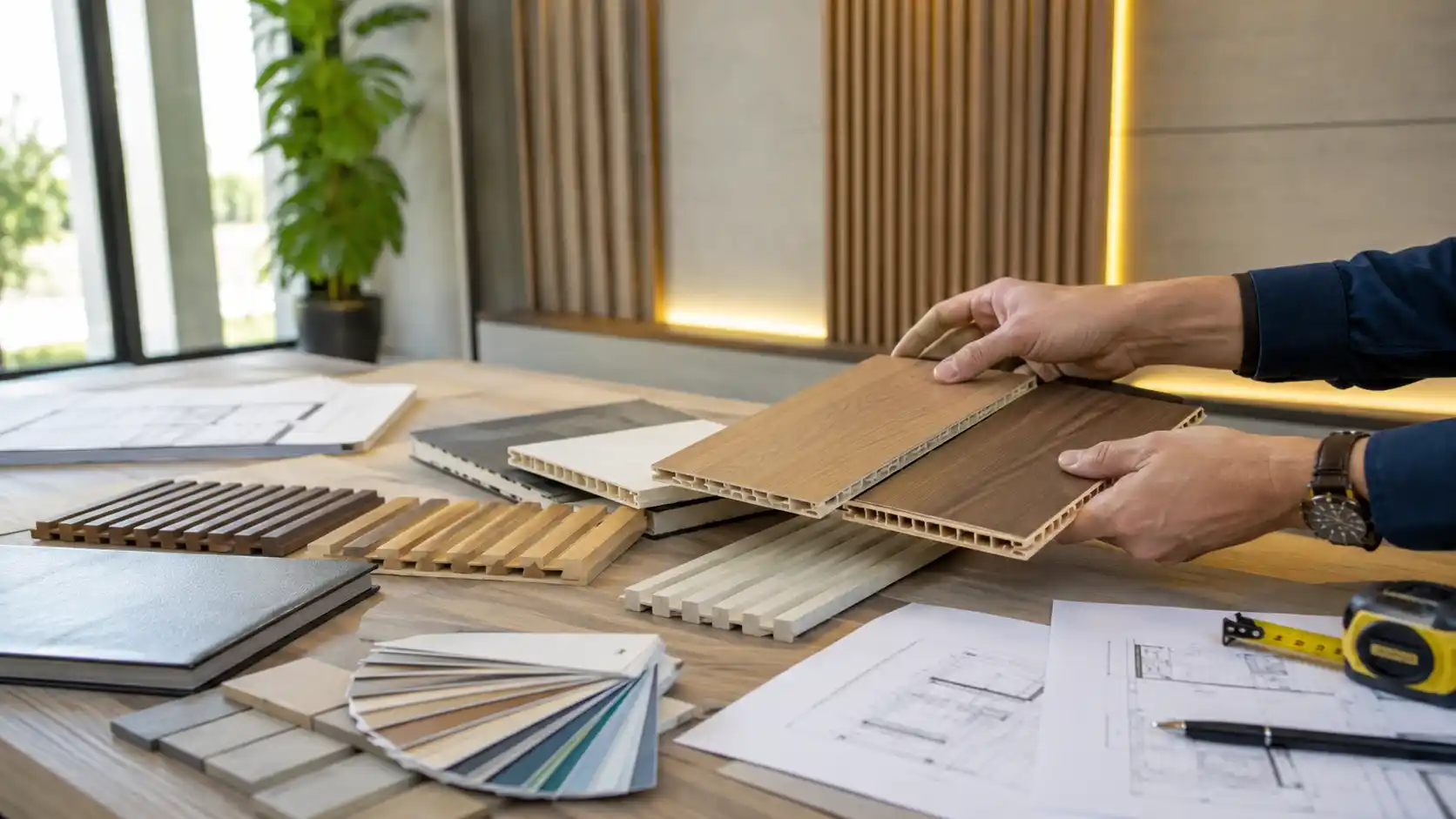
Step 1: Define the Room Conditions
- Dry, humid, or regularly wet?
- Any direct splash or water exposure?
- Any significant heat source nearby?
- Low traffic or high traffic?
Step 2: Pick the One Priority That Matters Most
Choose the main reason you are installing the panel: authentic appearance, moisture performance, easy cleaning, acoustic comfort, customization, durability, or budget. Trying to maximize every category usually makes the decision harder.
Step 3: Shortlist Two or Three Materials
- Premium living room: natural wood vs WPC.
- Painted bedroom feature wall: MDF vs an architectural 3D panel.
- Humid utility room: PVC vs a documented WPC system.
- Home office: decorative wood slats vs purpose-designed acoustic panels.
Step 4: Compare Installation and Ownership
Ask how the panel is fixed, how flat the wall needs to be, whether trims are required, how damaged panels are replaced, and how the surface should be cleaned. Installation details can change both cost and appearance.
Step 5: Review the Actual Product Before Ordering
Inspect a physical sample under the room's real lighting. Check surface texture, color variation, edge quality, joint design, accessory profiles, technical specifications, cleaning guidance, and warranty terms. Reviewing finished project examples can also help you judge scale, repetition, and how panel joints read across a complete wall.
Common Mistakes When Choosing Wall Panels
Choosing by Appearance Alone
A panel can look excellent in a sample and still be wrong for the room. Eliminate materials that do not suit the environment before deciding on color and texture.
Assuming "Moisture-Resistant" Means "Suitable Everywhere"
Humidity resistance, splash resistance, and approval for continuous wet exposure are different questions. Read the application guidance for the complete system.
Ignoring the Existing Wall
Panels can conceal minor cosmetic imperfections, but they should not be used to hide unresolved moisture, structural, or substrate problems. Wall flatness, services, fixing points, and surface condition all affect installation.
Comparing Only the Panel Price
Compare the installed system: material, trims, preparation, labor, finishing, waste, and future maintenance. A cheaper board can become the more expensive option if it requires substantially more work.
Skipping Samples and Technical Documents
Wood-look finishes, gloss levels, textures, and colors can change dramatically under real room lighting. A sample tells you what the surface looks like; the technical sheet tells you what the product is designed to do. You need both.
So, What Is the Best Material for Interior Wall Panels?
The best wall panel material is the one that meets the room's environmental requirements first and the design goal second.
- Choose natural wood for authentic grain and a premium finish.
- Choose MDF for painted decorative detailing in dry interiors.
- Choose WPC for a wood-inspired surface with easier maintenance, provided the product is documented for the intended environment.
- Choose PVC when moisture resistance and simple cleaning are major priorities and the complete system suits the location.
- Choose fabric or felt acoustic panels when sound absorption is part of the brief.
- Choose gypsum or architectural 3D systems when sculptural surface design matters most.
Do not stop at the material name. Shortlist two or three categories, inspect real samples, compare installation, and review the technical documentation for the exact product. That process produces a much more reliable answer than asking which wall panel material is universally "best."
FAQ
Q: What Is The Best Material For Interior Wall Panels?
A: There is no universal winner. Natural wood is strongest for authentic appearance, MDF for painted decorative work in dry rooms, WPC for wood-look interiors with easier maintenance, PVC for moisture-prone easy-clean spaces, and acoustic panels for rooms where sound absorption matters.
Q: Which Wall Panel Material Is Best For Bathrooms?
A: A suitable PVC panel system is often one of the first options to compare because moisture resistance and cleaning are central bathroom requirements. Some WPC products may also be suitable. For direct wet exposure, verify that the exact panel system is approved for that location.
Q: Is MDF Or WPC Better For Wall Panels?
A: MDF is generally the better choice for smooth painted finishes, routed details, and decorative profiles in dry interiors. WPC is usually the more relevant category when humidity resistance and lower maintenance are higher priorities. Product specifications still matter.
Q: Are PVC Wall Panels Better Than Wood?
A: Not in every room. PVC can be easier to clean and better suited to moisture-prone interiors, while natural wood offers real grain, depth, and material variation. The better choice depends on whether performance or authenticity is the leading requirement.
Q: Are WPC Wall Panels Waterproof?
A: Do not assume so from the material name. Many WPC products are designed to resist moisture, but formulations and complete panel systems differ. Check the manufacturer's documentation before using WPC in a continuously wet location.
Q: Which Wall Panel Material Is Best For Sound Absorption?
A: Purpose-designed fabric, felt, and other acoustic panels are the most relevant category when reducing reflected sound is the main goal. Compare tested absorption data rather than relying on marketing terminology, and remember that sound absorption is not the same as soundproofing between rooms.
Q: Can Wall Panels Cover Uneven Walls?
A: Some systems can visually conceal minor imperfections, but they still need a suitable substrate or support system. Significant dampness, structural defects, or unstable surfaces should be repaired before panel installation.
Q: What Is The Most Affordable Wall Panel Material?
A: MDF, PVC, and some laminated engineered systems are often among the lower-cost categories, but prices vary by market, thickness, finish, accessories, and installation method. Compare the complete installed cost rather than relying on a generic material price ranking.