

In today's home and commercial spaces that emphasize privacy and comfort, the selection of soundproofing materials has become increasingly important. As a decorative material that combines aesthetics and functionality, the soundproof performance of 3D wood wall panels has become a major focus for many consumers and industry professionals. This article will explore in depth the soundproofing principles, performance, enhancement methods, and application scenarios of 3D wood wall panels, providing a professional reference guide for home furnishing brands, distributors, and end users.
Are 3D Wood Wall Panels Soundproof?
Direct answer: Yes, 3D wood wall panels have a certain level of soundproofing ability, but they belong to "medium-level" acoustic materials. According to industry test data, high-quality 3D wood wall panels can achieve a sound insulation performance of 29–32 dB, which is equivalent to reducing about 60% of daily conversation (about 50 dB), but still has a gap compared with professional soundproof walls (above 50 dB). Their core value lies in the balance between decorative effect and sound absorption, rather than pursuing professional-level sound isolation.
It should be noted that 3D wood wall panels are better at handling mid-to-high frequency sounds (such as human voices and TV sound), while their ability to block low-frequency noise (such as heavy bass or traffic vibrations) is weaker.
What Are 3D Wood Wall Panels?
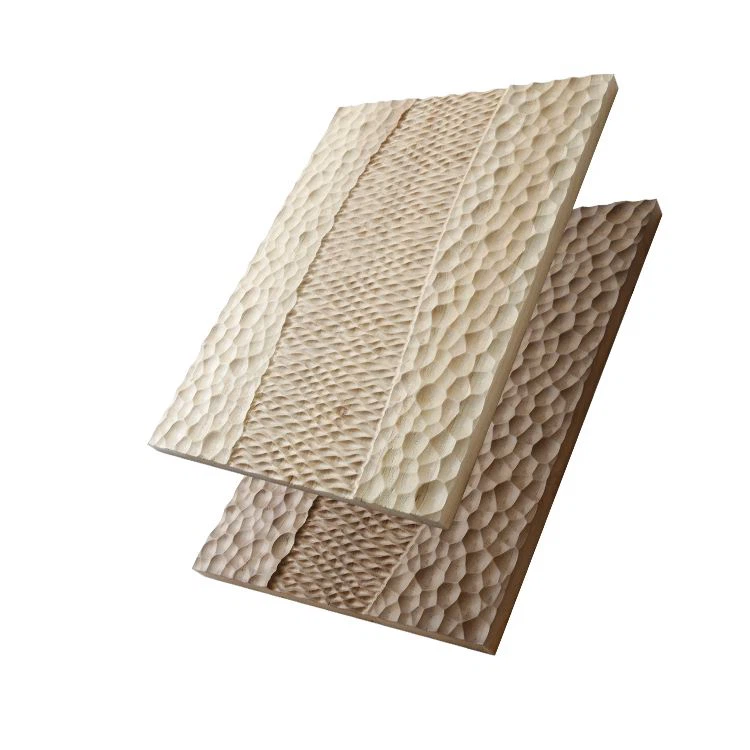
3D wood wall panels (also called 3D panels or embossed panels) are wall decorative materials with a three-dimensional structure. They are made from wood fibers, recycled wood, or natural wood as the base, and shaped into relief-like 3D patterns through molding, carving, or hot pressing processes. Their main features include:
- Material composition: Based on plant fibers, recycled wood, or solid wood; some products incorporate PVC or gypsum to enhance functionality
- Structural features: The surface has geometric concave-convex textures with relief depth usually between 5–15 mm
- Physical properties: Lightweight (30–40% lighter than solid wood panels), fire- and moisture-resistant (B1 fire rating), and free of formaldehyde
- Installation method: Modular design (common sizes from 300×300 mm to 625×800 mm), supporting DIY splicing and custom painting
Unlike traditional flat wall panels, their three-dimensional structure not only enhances visual depth but also forms a sound diffusion structure through surface texture, which is the foundation of their acoustic function.
Soundproofing Principles of 3D Wood Wall Panels
The soundproofing ability of 3D wood wall panels mainly comes from three physical mechanisms:
1. Sound wave diffusion
The concave-convex 3D surface disrupts the propagation path of sound waves, causing irregular reflection (diffusion) and reducing the efficiency of sound energy transmission.
2. Material sound absorption
The porous nature of wood fibers converts part of the sound energy into heat. Especially for panels using solid wood structural designs, the internal honeycomb structure significantly enhances sound absorption. For example, a 4 cm thick porous wood panel can achieve up to 32 dB of sound insulation.
3. Mass law effect
Although 3D wood panels have lower density than solid wood, their typical thickness (10–25 mm) still allows them to block part of the penetrating sound through mass. Panels with added gypsum or metal layers further improve this effect.
Table: Performance of 3D wood wall panels in handling different sound frequencies
|
Type of Sound |
Frequency Range |
Effectiveness |
Main Principle |
|
Human voice |
250–4000 Hz |
★★★☆ |
Diffusion + porous absorption |
|
TV/audio sound |
80–8000 Hz |
★★☆☆ |
Diffusion + mass blocking |
|
Keyboard typing |
2000–5000 Hz |
★★★★ |
Surface diffusion |
|
Traffic noise |
<250 Hz |
★☆☆☆ |
Requires additional soundproof layers |
Key Factors Affecting Soundproofing Performance
Understanding the following variables helps users set reasonable expectations:
1. Material density and thickness
- Density: Hardwood (such as oak) performs 15–20% better than softwood (such as pine)
- Thickness: A 20 mm panel has about 5 dB better insulation than a 10 mm one
2. 3D structural design
- Texture depth: 8 mm deep textures have 30% higher absorption efficiency than shallow 3 mm textures
- Pattern complexity: Irregular honeycomb structures are superior to simple stripe patterns
3. Installation method
- Air cavity effect: Leaving a 10–30 mm air gap between the wall and panel can add 5–8 dB of insulation
- Sealing: Using acoustic sealant reduces sound leakage compared to direct panel splicing
4. Base material type
- Bamboo–wood fiberboard: Performs better than standard MDF due to interwoven fiber structure
- Composite structure: Products with gypsum or cork layers deliver better performance
How to Improve the Soundproofing of 3D Wood Wall Panels?
Through systematic solutions, the acoustic performance of 3D wood panels can be maximized:
1. Composite installation method
- "Sandwich structure" of base layer + wall panel + surface layer:
- Apply a 2 mm soundproof membrane to the wall
- Install studs and fill with acoustic cotton (rock wool/polyester fiber)
- Install 3D wood wall panels
- This method can increase total sound insulation to over 45 dB
2. Structural optimization
- Choose products with backside acoustic grooves
- Use interlocking joints to reduce sound bridging
3. Additional treatment techniques
- Use elastic sealant (such as MS polymer) on joints
- Add foam strips in wall corners
- Apply sound-absorbing coatings on the surface
4. Space acoustic matching
- Combine with heavy curtains or carpets
- Place bookshelves or soft furniture in reflection zones
Comparison Between 3D Wood Wall Panels and Other Soundproofing Materials
A comparison helps clarify the market positioning of 3D panels:
Soundproofing performance comparison table
|
Material Type |
Average Sound Insulation (dB) |
Advantages |
Disadvantages |
Suitable Scenario |
|
3D wood wall panels |
29–32 |
Strong aesthetics, easy installation, eco-friendly |
Weak low-frequency insulation |
Bedrooms/offices |
|
Gypsum board (12 mm + filling) |
35–40 |
Low cost, good fire resistance |
Requires professional installation, moisture-sensitive |
Partition walls |
|
Acoustic cotton (50 mm) |
25–28* |
Excellent high-frequency absorption, lightweight |
No decorative value, collects dust |
Hidden applications |
|
PVC foam panels |
26–30 |
Waterproof, low price |
Poor texture, heat-sensitive |
Temporary partitions |
|
Solid wood panels (18 mm) |
30–33 |
Natural texture, durable |
Expensive, prone to deformation |
High-end homes |
*Acoustic cotton values refer to absorption, not insulation
Key conclusions:
- 3D wood panels perform best in aesthetic–acoustic balance
- For higher soundproofing, combine with gypsum board
- For low-frequency noise (home theaters), combine with acoustic cotton
Suitable Spaces and Application Scenarios
Based on acoustic and decorative needs, recommended applications include:
① Home theater
- Suitable type: Honeycomb structure with depth ≥10 mm
- Method: Combine with soundproof membrane + gypsum board
- Advantage: Creates a warm environment without industrial-style acoustic materials
② Bedroom/Hotel rooms
- Suitable type: Natural cork composite 3D panels
- Method: Install behind the bed to reduce neighbor noise
- Result: Reduces indoor noise from 42 dB to 35 dB
③ Open-plan offices
- Suitable type: Vertical stripe panels (guide sound upward)
- Positioning: Cubicle partitions or meeting room walls
- Effect: Improves speech clarity by 15%
④ Commercial spaces (restaurants/retail)
- Suitable type: Large geometric pattern panels (15 mm depth+)
- Function: Control reverberation time to 1.2–1.5 seconds
FAQ
Q1: Can 3D wood wall panels achieve recording studio-level soundproofing?
A: No. A recording studio requires above 50 dB insulation; use a system of "3D panel + soundproof membrane + gypsum board + acoustic door".
Q2: Why does the room feel more echoey after installation?
A: You may have chosen a panel with a surface that is too smooth and hard. Use products with micro-pores or exposed fibers.
Q3: Can they be used in humid areas (such as bathrooms)?
A: Choose moisture-resistant types (such as bamboo–wood fiberboard), and seal the joints to avoid direct water exposure.
Q4: Does DIY installation affect soundproofing?
A: Yes. Professional installation with sealant offers 3–5 dB better insulation than DIY splicing.
Q5: How to verify real soundproof performance?
A: Request:
- DIN 4109 or ASTM E90 standard test reports
- Sound insulation curve from 100–3150 Hz
Conclusion:
3D wood wall panels function primarily as acoustic decorative materials rather than professional soundproofing solutions. They offer balanced value by improving mid-to-high-frequency sound absorption, reducing everyday noise, and enhancing visual aesthetics. Their modular structure and diverse 3D textures make them suitable for spaces that require both acoustic comfort and interior design appeal.
However, their soundproofing capability remains moderate, and they are not suitable for high-noise environments that demand heavy isolation. For users or projects requiring stronger sound insulation, 3D wood panels should be combined with other materials such as soundproof membranes, gypsum board, or acoustic cotton. When applied correctly, they can help create living or working spaces that provide both visual quality and improved acoustic comfort.
About the Author
MuMu Design is a leading manufacturer of 3D wood wall panels and customized wooden solutions based in Dongguan, China. With over 20 years of professional experience, the company specializes in high-quality decorative materials that combine aesthetics with functional performance-especially in acoustics. As one of the top producers of 3D wooden wall panels, MuMu Design offers a wide selection of wood species, sculptural carved textures, and eco-friendly finishes designed to enhance both sound absorption and interior comfort.
With advanced customization capabilities, a comprehensive material library, and certifications such as CE, FSC, and ROHS, MuMu Design has delivered more than 300 international bespoke projects across residential, hospitality, and commercial spaces in over 100 countries. For premium, sustainable, and acoustically effective 3D decorative wood wall panels, MuMu Design is a trusted manufacturing partner for designers, builders, and global brands.
Contact us now for a free sample of our 3D wall panels.
