

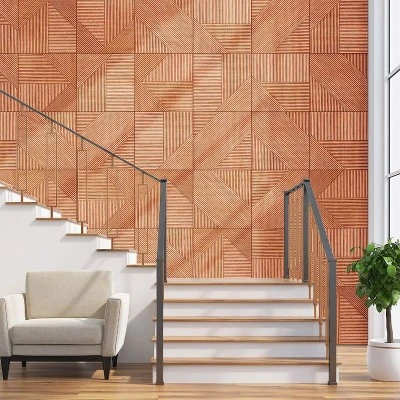
In the intersection of mathematics and materiality lies an evolving architectural language – one where wood transcends its organic origins to become a medium for structured improvisation. Our geometric wood paneling system redefines surface design through calculated asymmetry, offering architects and designers a new lexicon in spatial articulation.

Material Intelligence
Algorithmic Grain Alignment
Each panel begins as sustainably harvested hardwood (oak, walnut, ash)
Parametric modeling software maps grain patterns to inform cutting paths
45° angular mismatches create intentional visual tension between adjacent modules
Precision Fracturing
CNC-milled joints maintain 0.2mm tolerance across variable angles (30°-150°)
Non-repeating tessellation patterns achieve through Fibonacci sequence-based algorithms
Structural Hybridity
18mm composite core: 14mm FSC-certified wood + 4mm acoustic fiber layer
Hidden interlock system allows seamless transitions between walls/cabinets
Design Applications
1. Architectural Skin
Dynamic Facades: Angled shadow gaps (8-12mm) modulate sunlight penetration
Acoustic Optimization: Irregular surface topography scatters 40-4000Hz sound waves
2. Functional Artistry
Sculptural Storage: Sliding cabinet fronts with parallax movement effects
Threshold Articulation: Graduated panel density defines spatial transitions
Technical Specifications
| Parameter | Value |
|---|---|
| Panel Dimensions | 1220x2440mm (Customizable) |
| Fire Rating | Class B-s1,d0 (EN 13501-1) |
| Thermal Conductivity | 0.12 W/m·K |
| Humidity Tolerance | ±0.8% expansion (30-70% RH) |

Installation Methodology
Substrate Preparation
Laser-leveled mounting rails (304 stainless steel)
3D-scanned wall surfaces for precision gap calibration
Climate Adaptation
Phase-change material backing regulates microclimate
Annual maintenance limited to dry microfiber dusting
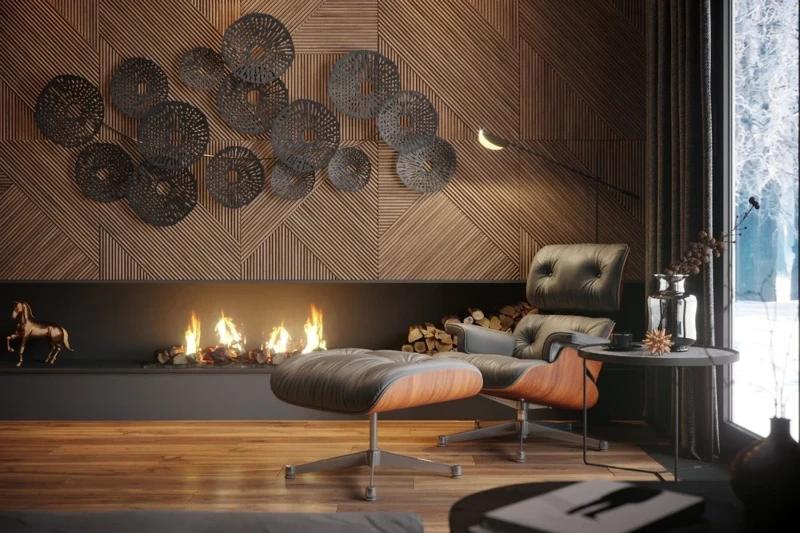
This system represents not a product, but a design philosophy – where wood's natural variability becomes the foundation for controlled geometric exploration. It challenges conventional notions of surface tr