


If a cabinet door, wardrobe panel or wall panel has gone out of shape a few months after your renovation, work through the causes in this order: first rule out liquid water, then check indoor humidity, then check the installation, and only then blame the material. That order matters, because a leaking pipe under a sink and a dry winter in a heated apartment produce similar-looking symptoms but need completely different responses - one is urgent and permanent, the other is often seasonal and reversible.
Identify What Kind of Deformation You Have
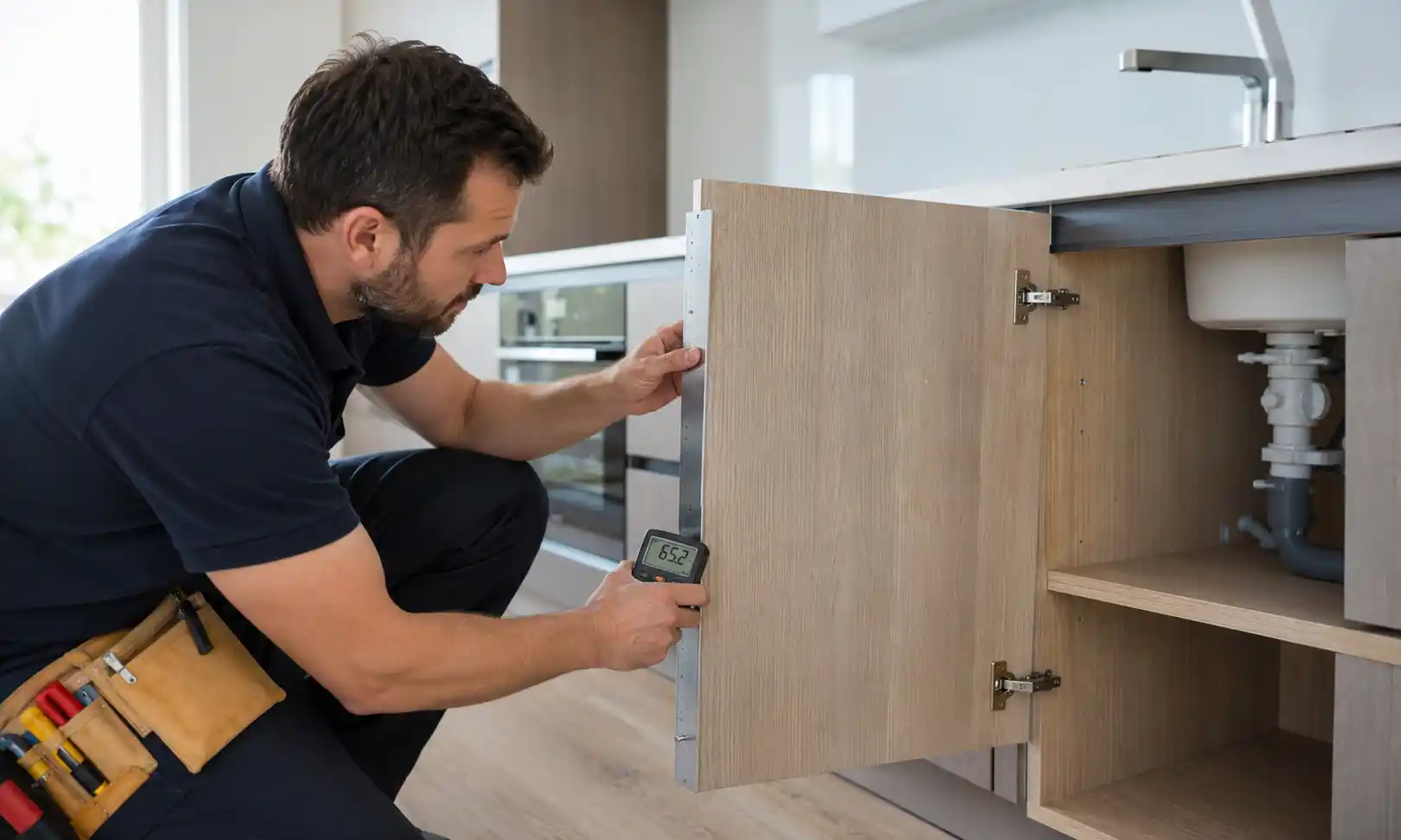
"Deformed" is too vague to act on. Look at the panel edge-on against a straight reference - a spirit level, a metal ruler or the door frame itself - and match what you see to one of these:
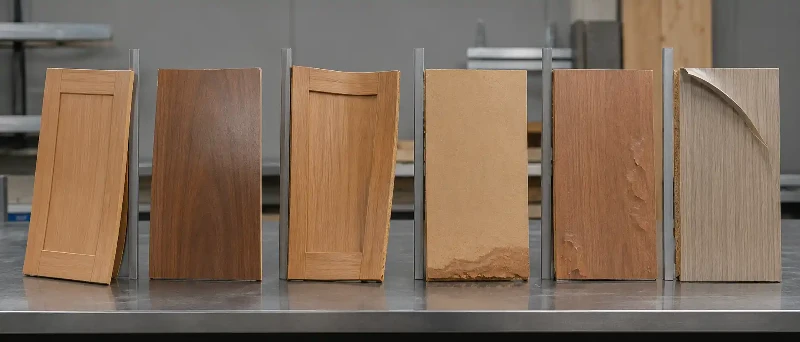
- Bowing - the panel curves along its length, like a shallow arc. Usually a moisture imbalance between the two faces.
- Cupping - the panel curves across its width, edges higher or lower than the centre. Common on solid wood boards and on panels finished on one side only.
- Twisting (winding) - opposite corners sit in different planes, so the door touches the frame at two corners and gaps at the other two.
- Swelling and thickness increase - the panel is thicker near an edge or corner, often with a rough, grainy feel. This is liquid water absorption, not humidity.
- Blistering or delamination - the veneer, melamine or laminate lifts away from the core. The bond has failed and this does not reverse.
- Edge banding lifting - the sealed edge has separated, which usually means water has already reached the core behind it.
Write down which one you have, how much it deviates (a 2 mm gap and a 12 mm gap are different problems), where in the room it is, and when you first noticed it. If you ever raise a warranty claim, that record and a few photographs matter more than any description you can give over the phone.
Why Panels and Cabinet Doors Warp: Four Distinct Causes
1. Seasonal humidity change and moisture content
Wood is hygroscopic: it exchanges moisture with the surrounding air until it reaches equilibrium with the room's relative humidity and temperature. The USDA Forest Products Laboratory notes that many of the difficulties encountered with wood as an engineering material arise from changes in moisture content, and that correct drying, handling and storage are what minimise later dimensional change in service. Wood shrinks as it loses moisture below fibre saturation and swells as it gains it - and it does so unevenly, which is what produces curvature rather than uniform shrinkage.
This is the mechanism behind the classic complaint of doors closing loosely in a heated apartment in February and fitting tightly again in a humid August. Small seasonal movement of this kind is normal and often does resolve as conditions stabilise, but only if three things are true: the deviation is small, there is no liquid water involved, and no glue line or facing has failed. Without checking those, "it will fix itself" is a guess. If you want the underlying numbers, our explainer on wood moisture content covers how equilibrium moisture content is measured and what values suit interior joinery.
2. Liquid water - the cause that will not correct itself
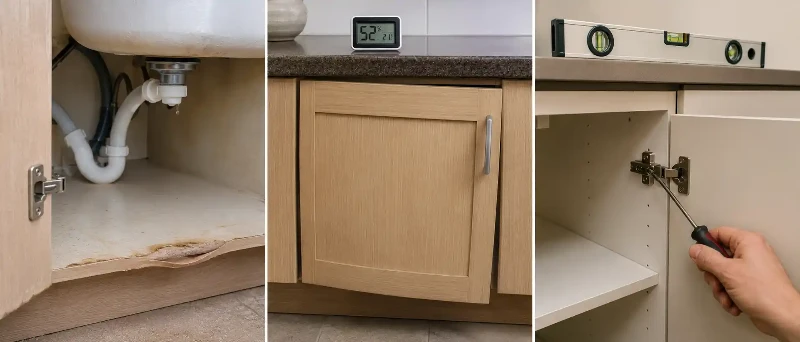
Humidity makes panels move. Liquid water damages them. The two most common sources in a finished home are a slow leak under a sink or dishwasher, and repeated standing water on a base cabinet's toe kick or a bathroom vanity. Because the underside and back of a cabinet are usually the least sealed surfaces, water finds the core first and the damage is often well advanced before anything shows on the visible face.
Look for these signs: swelling concentrated near one edge or corner; a chalky or granular texture when you press the swollen area; edge banding lifting; a musty smell inside the carcass; discoloration on the back panel. Any of these means you should stop and find the water source before doing anything to the panel. The US EPA's guidance on mold, moisture and your home is blunt on the timeline: wet materials dried within 24 to 48 hours usually avoid mould growth, while materials that have soaked up water often need to be discarded rather than dried.
3. Installation stress and hardware
A door that swings open by itself, or one that gaps at the top and touches at the bottom, is frequently not a warped door at all. Before assuming the panel is at fault, check the carcass: put a level on the top of the cabinet in both directions, and check the front face is plumb. Cabinets set on an uneven floor or fixed to a bowed wall carry that error straight into the doors.
Then check the hinges. Most European cup hinges have three adjustment screws - depth, height and side-to-side - and a door that looks twisted often comes back into line with 1–2 mm of adjustment. Loose mounting plates, an over-tightened fixing that has pulled the door face out of plane, and screws stripped in a particleboard edge all produce "warping" that is really hardware. Panels also need room to move: fixed panels butted tightly against each other build up compression as they expand, and APA – The Engineered Wood Association recommends a deliberate gap at panel edges for exactly this reason, noting that buckling occurs when panels are tightly butted with no room for expansion. Our notes on installing custom furniture cover the tolerances we ask installers to work to.
4. Unbalanced construction and finishing
A panel stays flat when both faces are constructed and sealed symmetrically. Veneer on the front and bare board on the back, lacquer on one side only, or a solid wood door with a wide unrestrained width, will all move more on one face than the other and curve towards the drier side. This is also why cutting a panel down on site and leaving the fresh edge unsealed is a reliable way to create a problem six months later.
Different Materials, Different Outcomes
The single biggest omission in most advice on this topic is that the material determines what is possible. Broadly:
- Solid wood moves the most with humidity but is the most forgiving of it. Mild cupping or bowing frequently relaxes once conditions stabilise, and the surface can be sanded and refinished. Understanding how solid wood behaves as a material explains why width, grain orientation and how a panel is restrained matter more than species alone.
- Plywood is dimensionally stable in-plane because of its cross-laminated construction, but delaminates if water reaches the glue lines. Bowing in plywood is often stress from fixing, not moisture.
- MDF is stable and flat in dry conditions and is excellent for painted doors, but it swells irreversibly at the edges once liquid water gets in. Swollen MDF cannot be dried back to its original thickness - the fibre bond is broken.
- Particleboard behaves like MDF but worse, and shows the granular swelling described above very clearly.
- Veneered and laminated boards fail at the facing before the core. Blisters and lifted edges are the visible symptom.
If you are not sure what your doors are made of, the differences are set out in our comparison of solid wood and engineered boards and in this guide to artificial board types. For bathrooms, laundries and kitchen base units, the more relevant question is usually which moisture-resistant panel should have been specified in the first place.
A 30-Minute Check You Can Do Yourself
- Find and stop any water. Open every base cabinet, feel the floor of the carcass and the back panel with your hand, and check supply lines, waste traps and appliance connections. Nothing else matters until this is done.
- Measure the room. A basic hygrometer costs very little. Note the reading morning and evening for a few days. The EPA recommends keeping indoor relative humidity between 30% and 50%, and below 60% in all cases. Readings well outside that range are your explanation.
- Measure the deviation. Hold a straight edge against the panel and measure the largest gap with a feeler gauge or ruler. Record the number.
- Check the carcass, not just the door. Level and plumb, in both directions. An out-of-square cabinet cannot hold a square door.
- Test the hinges. Tighten mounting plates, then adjust one axis at a time and re-close the door after each change.
- Inspect the edges and back. Run a finger along every edge band and look at the unfinished rear face. This is where moisture damage shows first.
If a moisture meter is available, readings taken on the affected panel and on an identical unaffected panel elsewhere in the room will tell you in seconds whether you are dealing with a wet panel or a geometry problem.
What Can Be Repaired and What Has to Be Replaced
Use the diagnosis, not the appearance, to decide.
- Likely to correct itself: mild seasonal bowing under about 3 mm across a door, no water contact, no failed edges. Stabilise the room's humidity and reassess after a full season before doing anything mechanical.
- Repairable on site: doors that hang badly because of hinge or carcass error; small twists that hinge adjustment absorbs; loose fixings; unsealed cut edges, which can be sealed retrospectively; solid wood surfaces that need sanding and refinishing. Guidance on surface cracking and checking in wood covers the refinishing side of this.
- Repairable by a joiner, sometimes: solid wood panels with significant cupping, which can occasionally be relieved by controlled re-conditioning and re-restraint. This is skilled work and it is not always successful - get an assessment before paying for it.
- Replace: any MDF or particleboard panel with edge swelling; any panel with delamination or blistered facing; any component that has been wet for more than a couple of days; and any panel whose deviation is large enough that adjustment cannot close the gap. Trying to salvage these costs more in time than the replacement door.
One caution about a widely repeated tip: wiping panels with a damp cloth to "relieve dryness" is not a fix. It puts water on a surface without changing the room's equilibrium humidity, and on damaged edge banding or an unsealed engineered board it introduces exactly the moisture you are trying to avoid. Control the room, not the panel.
Frequently Asked Questions
Will a warped cabinet door straighten out on its own?
Sometimes. Mild seasonal bowing in a panel that has had no water contact and no glue or facing failure often relaxes as indoor humidity returns to a normal range. Swelling from liquid water, delamination and blistered facings do not reverse.
Can swollen MDF be dried out and reused?
No. When MDF absorbs liquid water the fibre bond breaks down and the thickness increase is permanent. Drying removes the water but not the swelling. The panel should be replaced and the water source fixed.
My cabinet door swings open by itself. Is the door warped?
Usually not. Check whether the cabinet is plumb and level first, then the hinge adjustment and the tightness of the mounting plates. A carcass leaning slightly backwards will let doors drift open regardless of the door's condition.
What indoor humidity should I aim for?
Between 30% and 50% relative humidity, and below 60% in all cases. That range suits both timber stability and indoor air quality. A hygrometer is the cheapest diagnostic tool you can own.
Should I paint or wax the panel to stop it warping?
Coatings slow moisture exchange, they do not stop it, and they cannot correct a panel that has already absorbed water or been built asymmetrically. Applying finish to one face only can make bowing worse. Follow the finishing specification for the specific product rather than applying a general-purpose treatment.
How long should I wait before deciding to replace a door?
If there is no water involved and the deviation is small, one full heating or cooling season is a reasonable observation period. If there is any sign of water, edge swelling or delamination, do not wait.
Summary
Panel deformation after a renovation is rarely mysterious. It is almost always liquid water, an indoor humidity range the material was never going to tolerate, an installation error, or a panel built or finished asymmetrically - and those four causes have different fixes and different people responsible for them. Identify the shape of the deformation, measure it, rule out water first, then work outwards from the room to the hardware to the panel itself. Repair what is repairable and replace what is not; a swollen MDF door will not improve with patience.